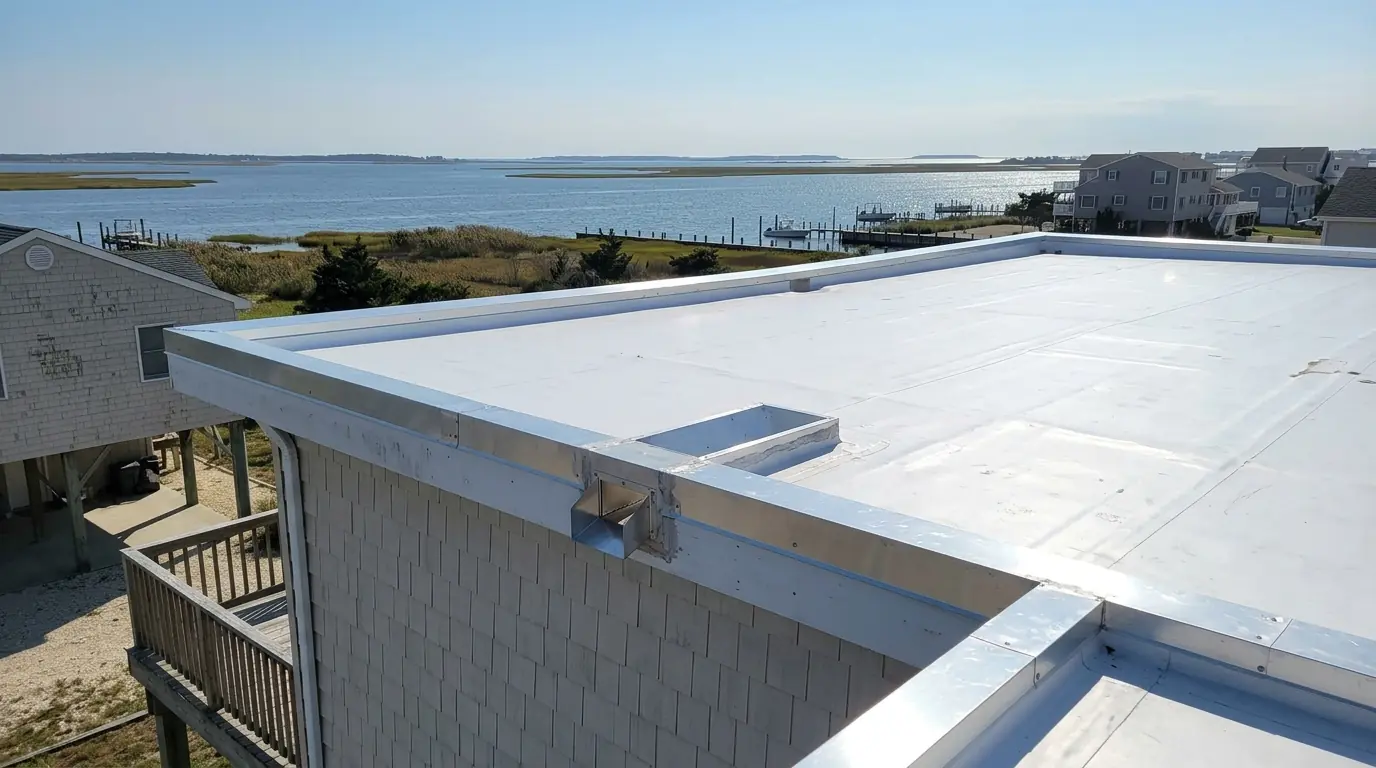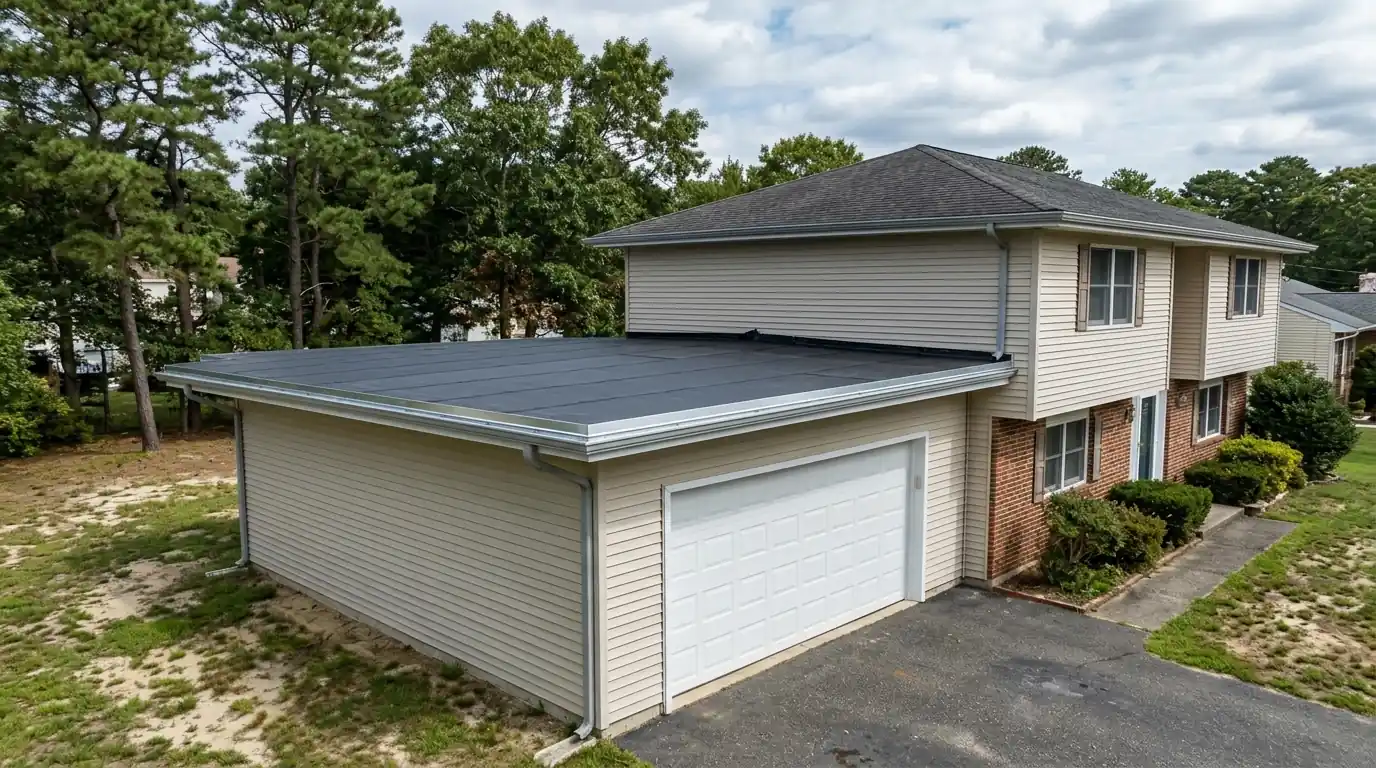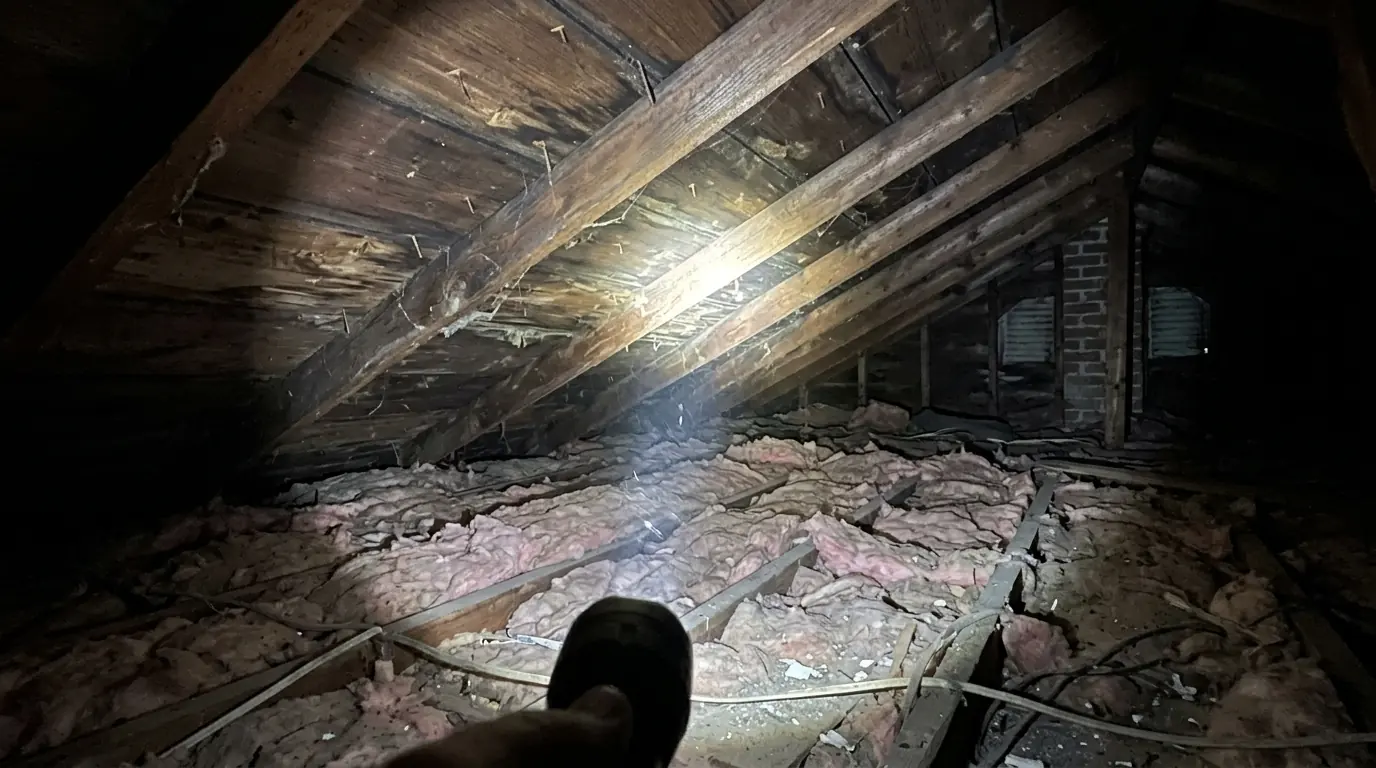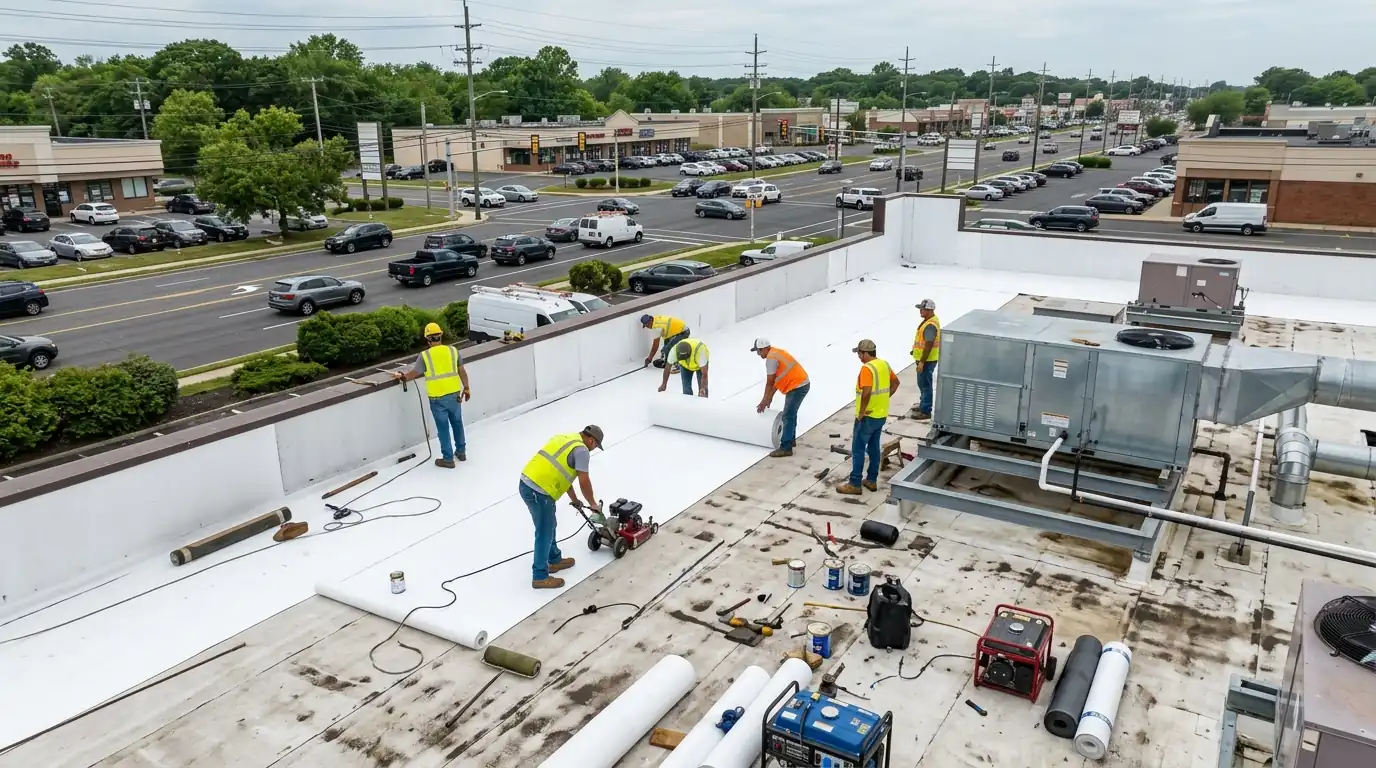
We handle commercial roofs from a single storefront up to a strip center or garden apartment complex: leak repairs, restoration coatings, and full TPO, EPDM or modified bitumen replacement. Many jobs run early mornings or weekends to keep customers and tenants unaffected. Call (732) 419-1462 any hour and tell us what kind of building it is.
Which fix makes sense for the roof you have
Commercial roofs rarely need replacing the first time someone calls about a leak. We start with what the roof can still give you, then lay out each path with its likely service life.
Targeted repair
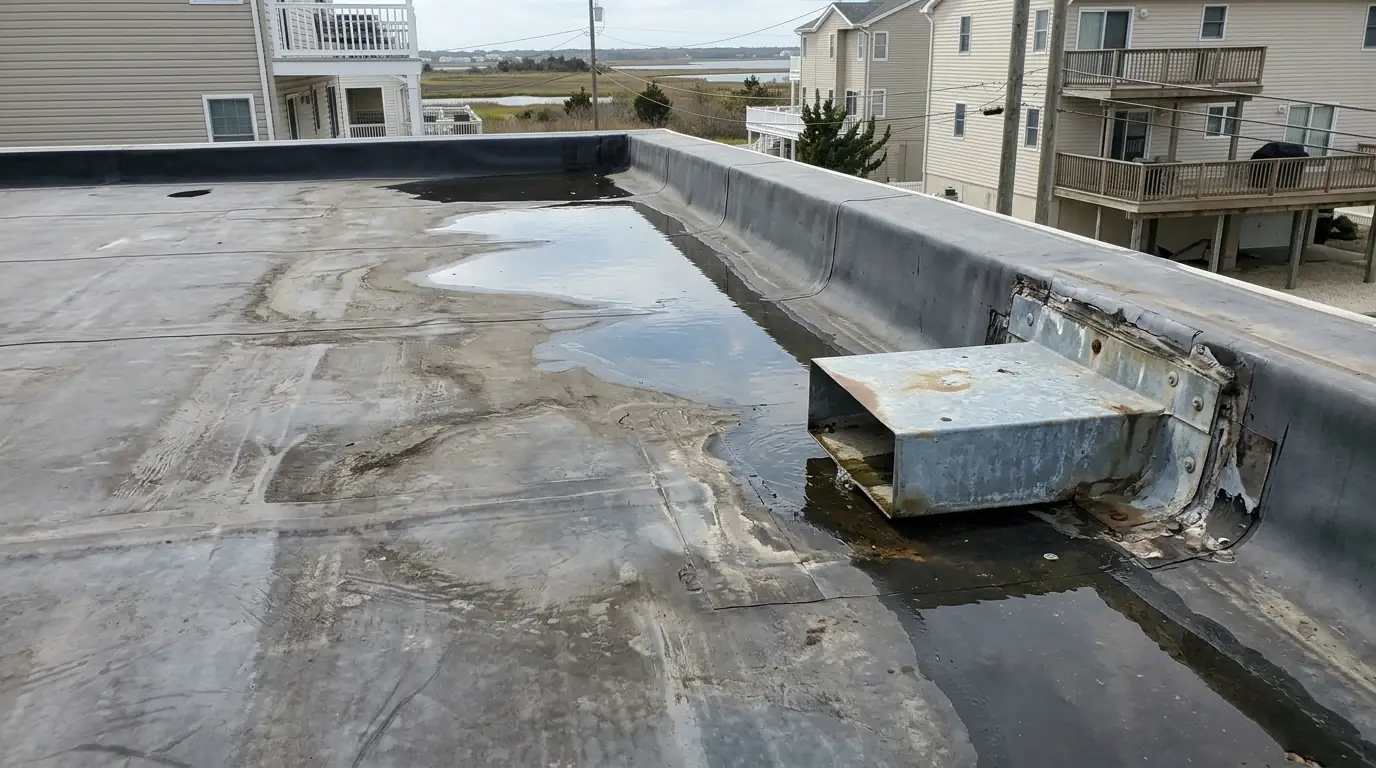
Split seams, failed pitch pans, torn flashing at a parapet or a punctured membrane under a rooftop unit. When the rest of the roof is sound, fixing the defect is the sensible move and buys years.
Restoration coating
Silicone or acrylic coatings rolled or sprayed over a dry, intact membrane or metal roof. It reflects heat, seals small cracks and can push off a full replacement when insulation readings come back dry.
Recover
A new cover board and membrane laid over one existing roof. It avoids most tear-off noise and debris, which matters on a busy plaza, but only works when moisture scans show dry insulation.
Full replacement
Everything comes off to the deck, wet insulation goes in the dumpster, and a new system with tapered slope goes down. This is the answer when water has spread through the insulation layer.
Metal roof repair
Older pre-engineered buildings near the marinas often have exposed-fastener panels. We replace rusted screws, reseal laps, swap corroded panels and fix the gutters that tend to fail along the eaves.
Steep-slope commercial
Churches, offices in converted homes and some apartment buildings carry shingle roofs. We handle those too, along with the flat sections behind parapets that usually hide from street view.
Which membrane suits which kind of building
Most low-slope commercial roofs in the county use one of three membranes. The building's use, rooftop equipment and exposure steer the choice more than price alone.
| Building type | Membrane we usually suggest | Why |
|---|---|---|
| Retail strip with rooftop HVAC | 60 or 80 mil TPO, mechanically fastened | Welded seams handle service traffic, white surface cuts cooling load |
| Restaurant with grease exhaust | TPO with grease-resistant flashings and sacrificial pads | Kitchen exhaust breaks down some membranes quickly |
| Church or school wing | Fully adhered EPDM or TPO | Quiet in wind, simple shapes, long service life |
| Marina building near salt water | TPO or coated metal with stainless fasteners | Salt air eats bare steel and cheap screws |
| Garden apartments, flat roofs | Modified bitumen or TPO | Handles foot traffic from contractors working on tenant equipment |
How we run a commercial job without closing your doors
A homeowner can step out for the day. A business usually can't. These steps keep work predictable for you, your staff and your customers.
Roof survey and core cuts
We walk the whole roof, photograph each defect, cut small cores to count layers and check insulation, and note every penetration and rooftop unit. You get the photos with a plain explanation of what they show.
1 to 3 hours on siteOptions with a schedule
You see repair, coating or replacement side by side, each with a price and a plan for which days are loud. We ask about deliveries, peak hours, worship services and tenant notices before we commit to dates.
Within a few daysStaging and protection
Dumpster and lift placement get worked out to keep parking and entrances open. We protect skylights, roof hatches and rooftop units, and we post signs where pedestrians might walk below the work area.
Day before startTear-off in sections
We only open as much roof as we can dry in the same day. On a strip center that often means one tenant bay at a time, so a sudden shower never finds an open deck over inventory.
Daily, often early hoursFlash every penetration
Curbs, pitch pans, drains, parapet walls and expansion joints get detailed before we call a section done. These spots cause most commercial leaks, so they get the slowest, most careful work on the job.
As each section closesCloseout package
You receive final photos, membrane and insulation product data, and the manufacturer's registration paperwork for the system. Facility managers tell us that package saves them hours at insurance renewal.
Final day
Typical commercial roofing ranges in Ocean County
Commercial pricing swings with roof size, access, number of layers and rooftop equipment. These 2026 figures give you a starting frame before we've seen the building.
| Work | Typical range | What moves the number |
|---|---|---|
| Leak repair visit with flashing or seam work | $465 to $1,870 | Height, access, number of defects found |
| Silicone restoration coating, per sq ft | $3.40 to $6.85 | Surface prep, seam reinforcement, coating thickness |
| TPO recover over one layer, per sq ft | $7.20 to $11.60 | Cover board type, edge metal, drains |
| Full tear-off and new TPO, per sq ft | $9.80 to $16.30 | Wet insulation, tapered slope, deck repairs |
| Exposed-fastener metal roof refastening, per sq ft | $1.95 to $4.40 | Panel replacement count, gutter work |
Every building is different, so treat these as rough guidance. We put a written price in your hands after the survey.
Leaks over tenants, inventory and congregations
When a commercial roof leaks, the first call is often about protecting what sits below. We'll tarp or patch a failed section the same day where conditions allow, then come back for a permanent repair once the roof is dry. If the water is coming through a light fixture or a ceiling grid, shut that circuit off before anyone touches it.
Property managers with several buildings sometimes ask for a roof walk on each one every spring and fall. That schedule catches clogged drains, loose parapet caps and cracked pitch pans before they cause stains in a tenant's space. Our roof inspection page explains what we check on a walk like that. On membrane roofs we also note seam condition by manufacturer, since a Carlisle or GAF TPO sheet from the 2000s ages differently from a sheet installed last year.
For apartment and condo buildings with shingled roofs and vinyl siding, the same crews can handle the siding repair that often goes with storm damage, which keeps one point of contact for the property.
Commercial roofs along Route 37, Route 9 and Hooper Avenue
Toms River is the county seat, and its commercial roofs are a mix of 1970s and 1980s strip centers, professional buildings near the courthouse, medical offices along Hooper Avenue, and newer plazas on Route 37. Many of the older ones have been recovered once already, so a second recover usually isn't an option and tear-off becomes the honest recommendation.
Wind off Barnegat Bay hits big flat roofs harder at the corners and edges, which is where we see membrane lift after a nor'easter. Salt air speeds up rust on metal buildings near the marinas along the Toms River and down toward Lacey Township. In summer, black roofs over retail space bake, and switching to white TPO at replacement noticeably cuts the strain on rooftop units. We plan big tear-offs for spring and fall when the weather is steadier and customer traffic is lighter than the summer rush.
Where we do this work most
We work across all of Toms River (08753, 08755 and 08757) and these neighboring towns every week, along with the rest of Ocean County and southern Monmouth County.
- Silverton, Toms River08753
- Pleasant Plains, Toms River08755
- West Dover, Toms River08755
- Ortley Beach, Toms River08751
- Lakewood08701
- Brick08723
- Jackson08527
- Howell07731
- Manchester08759
- Berkeley Township08721
- Lacey Township08731
- Stafford Township08050
- Barnegat08005
- Wall Township07719
- Freehold07728
- Point Pleasant08742