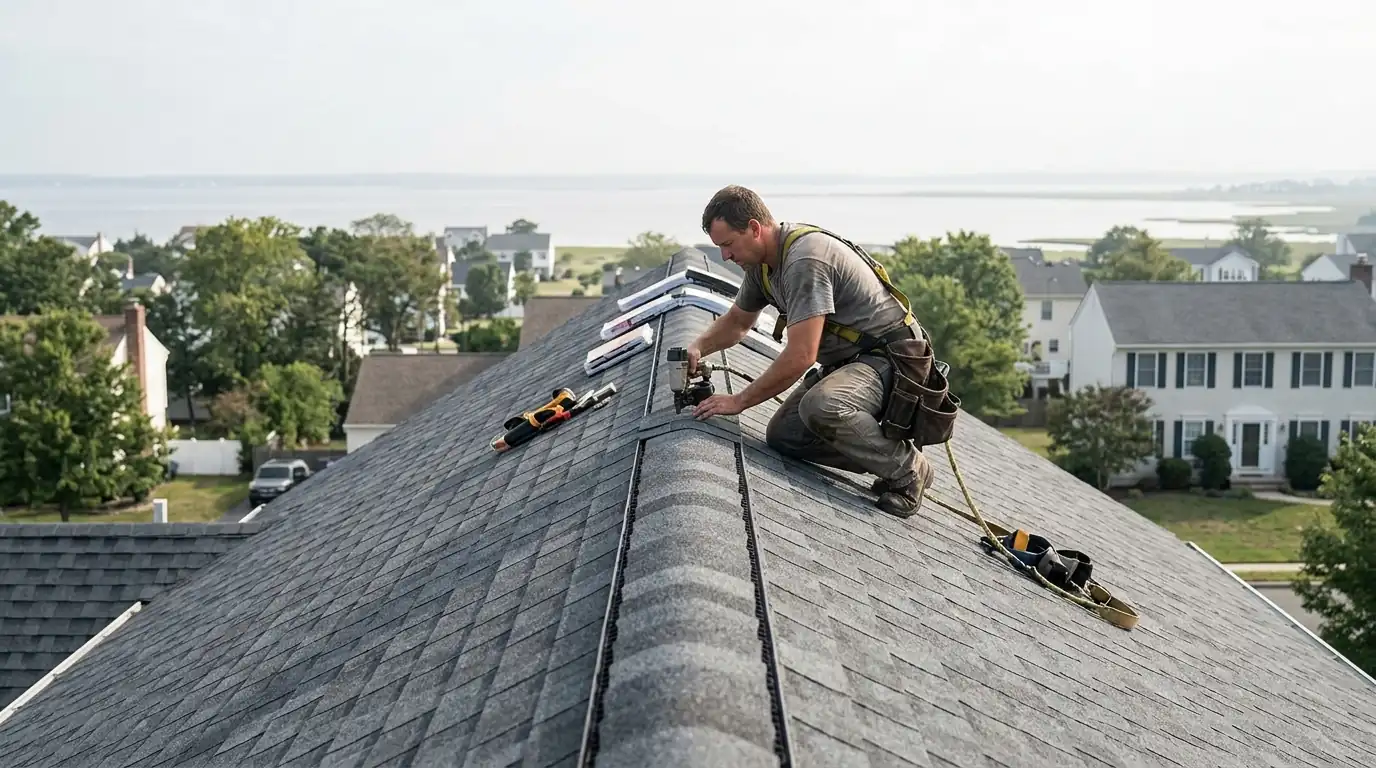
Good attic ventilation pulls outside air in through soffit vents and lets warm, moist air out near the ridge, in roughly equal amounts. Around Toms River, where bay humidity runs high, that balance keeps sheathing dry, slows shingle aging and reduces ice dams. We check intake, exhaust and baffles, then correct what's out of line. Call (732) 419-1462.
Signs your attic isn't breathing the way it should
You can spot most ventilation trouble with a flashlight from the attic hatch. These are the clues we look for first.
Dark blotches on the sheathing
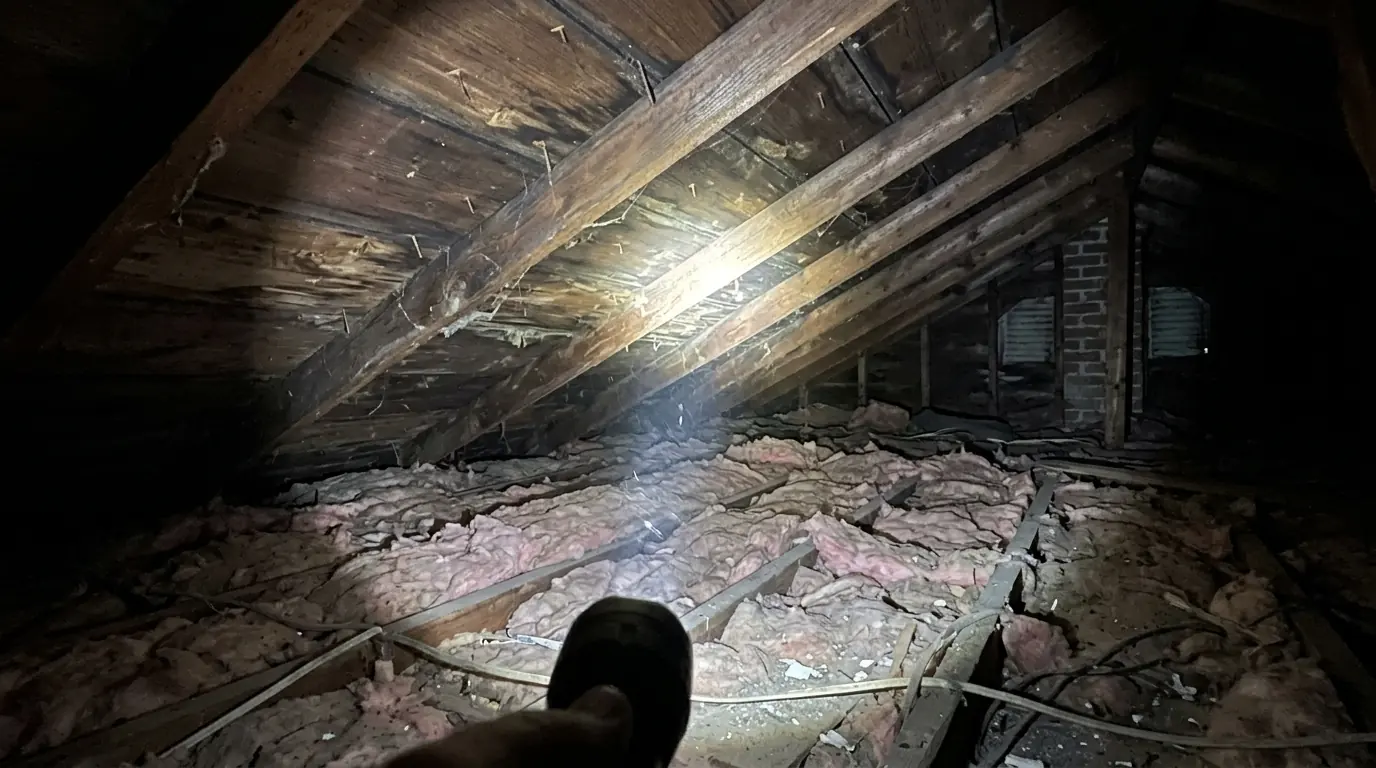
Gray or black patches on the underside of the plywood, often worst near the ridge or on the north slope, usually mean warm, moist air is condensing there long enough for mold to grow.
Frost or dripping nails
On a cold January morning, nail tips poking through the deck can carry frost. When the sun warms the roof, that frost melts and drips onto the insulation, which can look a lot like a leak.
Ice dams along the eaves
Ridges of ice at the roof edge usually mean attic heat is melting snow higher up. The water refreezes over the cold overhang and backs up under the shingles.
Blistering or curling shingles
Shingles that blister or curl long before their expected age often sit over an attic that overheats in July and August. Trapped heat ages the asphalt from underneath.
Insulation stuffed into the eaves
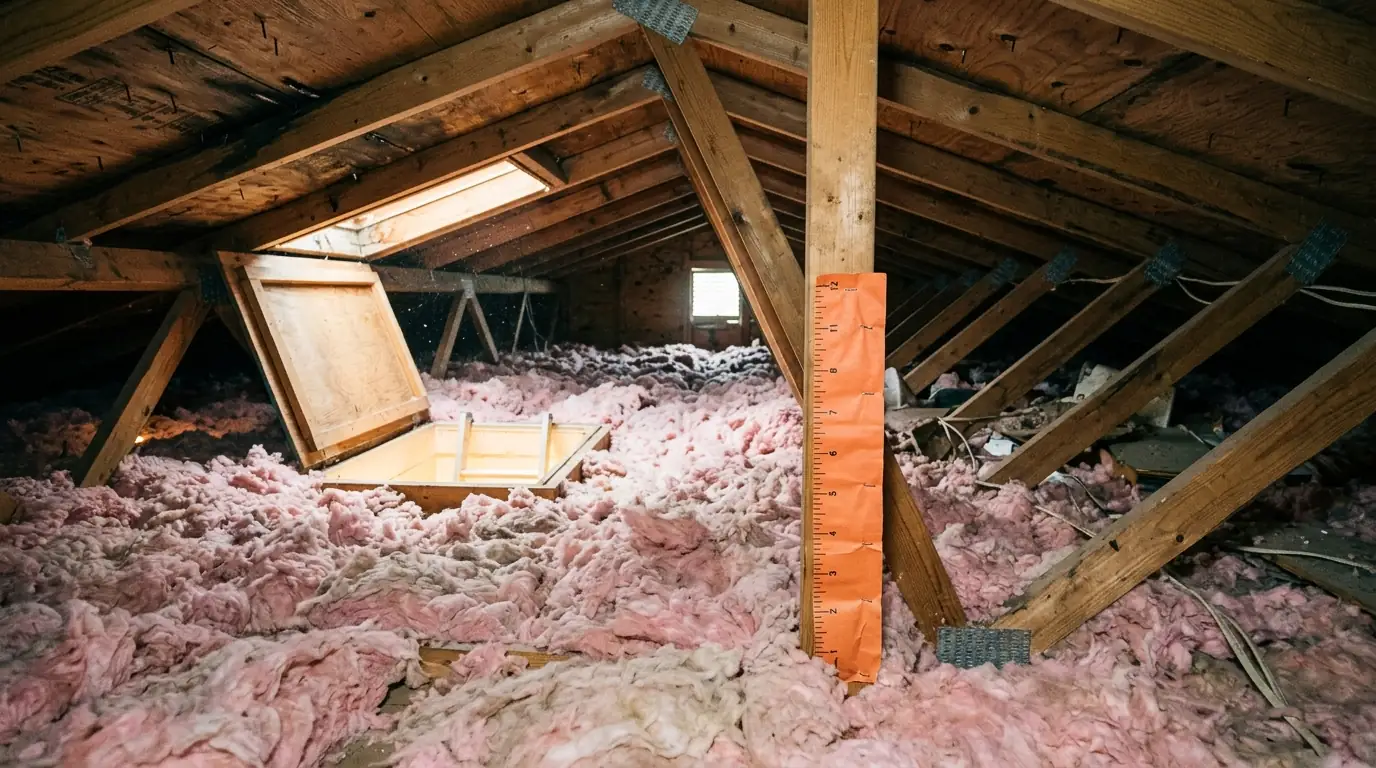
When insulation is pushed tight against the roof deck at the outer walls, outside air can't get in. The soffit vents look fine from the yard, yet nothing moves through them.
A musty smell or a stuck hatch
A hatch that swells shut in summer, or an attic that smells like a basement, points to trapped humidity with nowhere to go and a ventilation path that has stalled.
Which vents do what on a shore home roof
Every vent is either intake or exhaust. Mixing the wrong types on one roof is one of the most common problems we find.
| Vent type | Intake or exhaust | Where it works best |
|---|---|---|
| Continuous soffit vent | Intake | Homes with open overhangs, paired with baffles above the wall plate |
| Ridge vent (for example GAF Cobra or Owens Corning VentSure) | Exhaust | Most gable and hip roofs with enough ridge length to carry the attic |
| Box or static roof vents | Exhaust | Hip roofs with short ridges, or where a ridge vent isn't practical |
| Gable end louvers | Either, depending on wind | Older homes on their own; usually closed off once a ridge vent goes in |
| Powered or solar attic fan | Exhaust | Rare cases with ample intake; otherwise it pulls house air through ceiling gaps |
| Drip edge intake vent | Intake | Capes and ranches with little or no overhang at the eaves |
Why more vents won't help unless they're balanced
A common rule of thumb is about one square foot of open vent area for every 300 square feet of attic floor, split roughly half intake and half exhaust. The split matters as much as the total. A roof with a long ridge vent and a few blocked soffits is mostly exhaust, so the ridge pulls air from wherever it can, including bathroom and hallway ceiling gaps carrying warm, humid air up from the house.
Mixing exhaust types causes a different headache. A gable louver or power fan near a ridge vent can short-circuit the airflow, so the ridge draws air in from the gable instead of from the eaves, and the lower attic stays stagnant. Our fix is usually to give one exhaust system the job, close off the others, and make sure the eaves can actually feed it.
How we correct an attic that won't dry out
Most ventilation corrections take one day. Larger jobs, such as adding intake on a home with no overhang, can run a little longer.
Attic walk-through
We go up with a moisture meter and a strong light, note stains, frost marks and insulation depth, and measure the floor area so we know how much intake and exhaust the space needs.
45 to 90 minutesRoof and soffit check
Outside, we look at every existing vent, confirm the soffit panels are actually perforated and open behind, and note any gable louvers or fans that could be fighting a ridge vent.
30 to 60 minutesOpen up the intake
We install rafter baffles wherever insulation blocks the eaves, swap solid soffit for vented panels as part of our soffit and fascia work, or add an edge intake vent on homes with little overhang.
Half a daySet the exhaust
We cut or extend the ridge slot to the correct width, install a baffled ridge vent with a weather filter, and shingle over old box vents or seal a gable fan that competes with it.
2 to 4 hoursCut the moisture load
Bath fans that dump into the attic get ducted outdoors and the hatch gets weatherstripped. If the attic floor is thin, we'll talk through an insulation top-up to go with the vents.
1 to 2 hours
Typical ventilation costs for Toms River homes
Prices below are 2026 ranges for one-family homes. Roof pitch, ridge length, attic access and the condition of the soffit framing all move the number.
| Work | Typical range | What moves the number |
|---|---|---|
| Ridge vent added or replaced on an existing roof | $565 to $1,480 | Ridge length, cap shingle style, slot cutting |
| Soffit vent conversion or new vented soffit | $435 to $1,360 | Linear feet, condition of the fascia and soffit framing |
| Rafter baffles at the eaves | $290 to $820 | Number of rafter bays, how tight the attic is at the edges |
| Edge intake vent for homes with no overhang | $640 to $1,590 | Eave length, gutter removal and reset |
| Bath fan duct rerouted through the roof | $345 to $790 | Duct run length, roof cap and flashing |
Use these to plan, not as a quote. We'll price your attic after we've been up in it.
Is a new roof coming? That's the best time to fix the vents
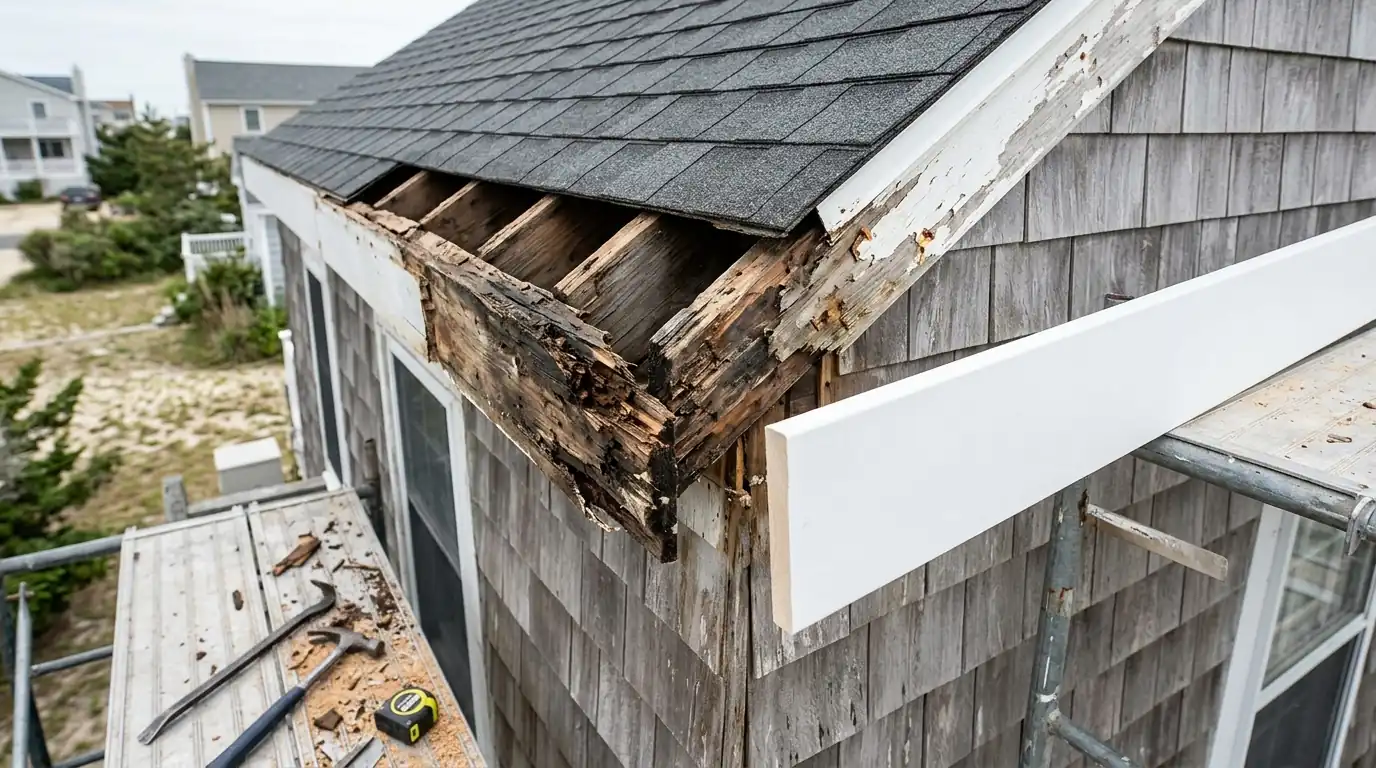
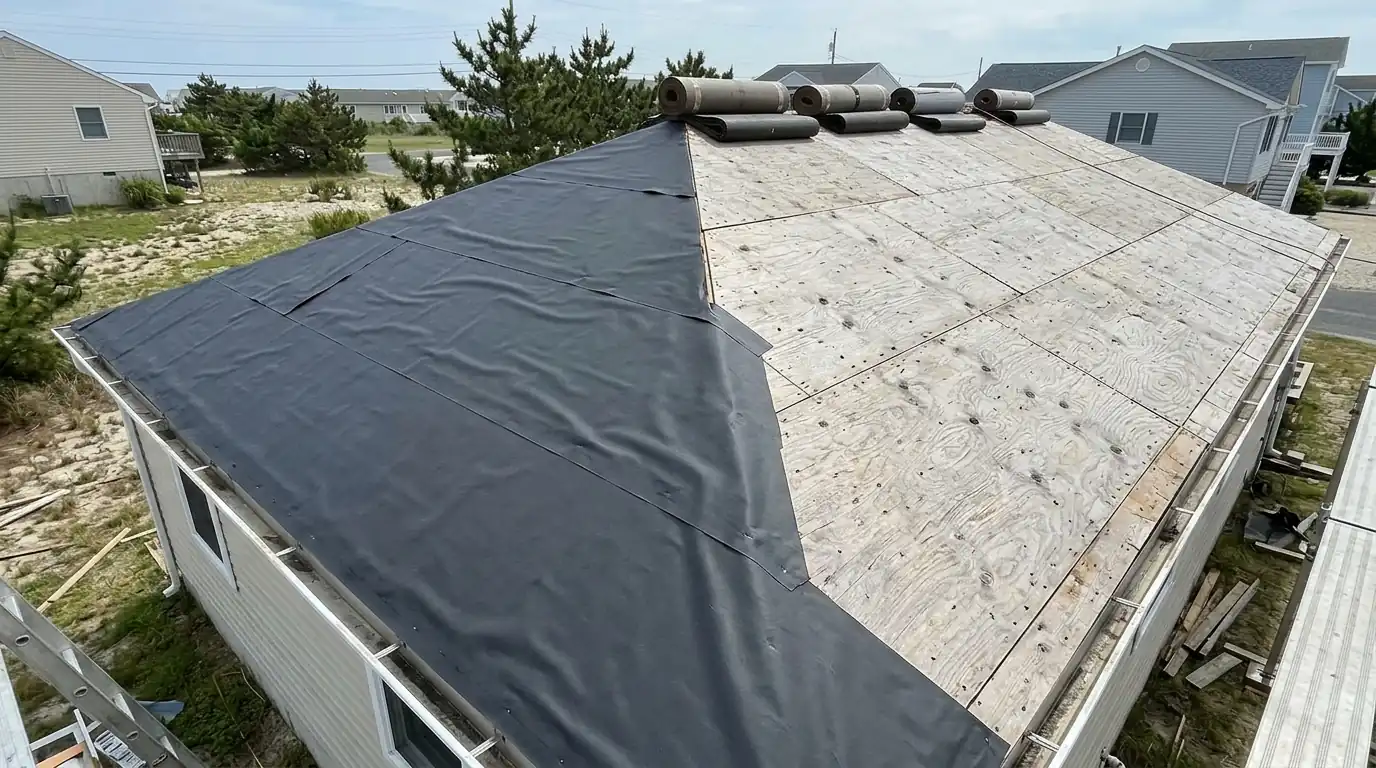
If a new roof is on your horizon, that's the cheapest moment to sort out ventilation. With the old shingles stripped, we can cut the ridge slot clean, add intake at the eaves and replace damp sheathing in one visit. Major shingle makers spell out ventilation requirements in their installation instructions, and a balanced attic is part of what their published warranty terms assume. Ask us to look at the attic before your roof replacement is priced, not after.
Why attics near Barnegat Bay stay damp
Air coming off Barnegat Bay and the ocean carries a lot of moisture, and Toms River summers stay humid well into September. An attic that can't exchange air soaks that in, then condenses it on the coldest surface it can find, which in winter is the underside of the roof deck. Pine shade over many inland lots keeps north slopes cool and slow to dry, too. Bathrooms vented into the attic, common in older homes here, only add to the load.
Housing age plays a part. Many 1960s and 1970s ranches, capes and bi-levels went up with a few box vents and gable louvers, and later insulation upgrades buried whatever soffit intake they had. Raised homes on the barrier island, including rebuilt houses in Ortley Beach, face steady salt wind, so we use vents with internal baffles and weather filters that stop blowing rain while still letting the attic breathe.
Where we do this work most
We work across all of Toms River (08753, 08755 and 08757) and these neighboring towns every week, along with the rest of Ocean County and southern Monmouth County.
- Silverton, Toms River08753
- Pleasant Plains, Toms River08755
- West Dover, Toms River08755
- Ortley Beach, Toms River08751
- Lakewood08701
- Brick08723
- Jackson08527
- Howell07731
- Manchester08759
- Berkeley Township08721
- Lacey Township08731
- Stafford Township08050
- Barnegat08005
- Wall Township07719
- Freehold07728
- Point Pleasant08742