Most roof leaks in Toms River start at flashing around chimneys, walls and skylights, at cracked vent pipe boots, or where wind-driven rain gets under shingle edges. Fixing one starts with finding the true entry point, which may sit several feet uphill of the stain. We trace it in the attic, confirm it with a water test, then repair it. Call (732) 419-1462.
What your ceiling stain is trying to tell you
Where a stain shows up, and when, narrows the search before we ever climb up. Here's how we read the clues homeowners describe on the phone.
| What you notice | Where we look first | Why |
|---|---|---|
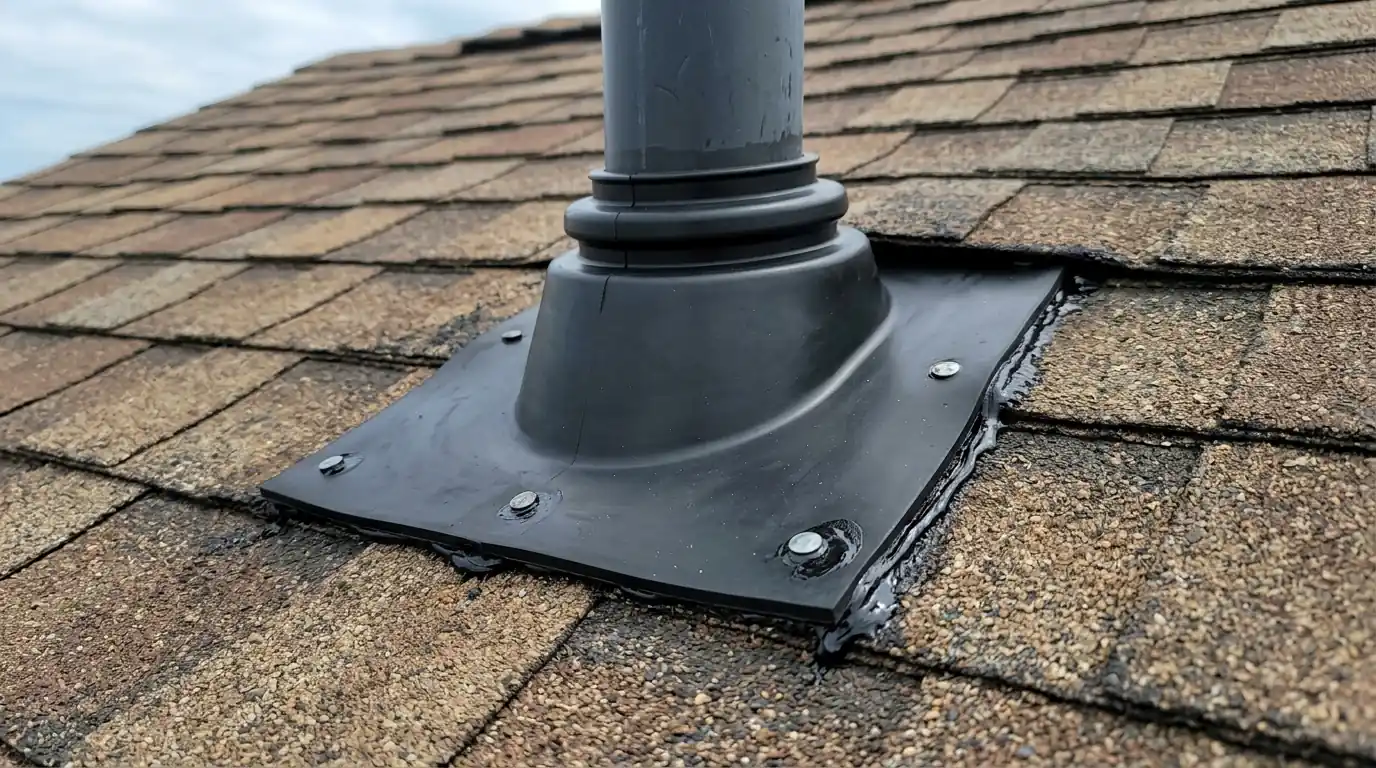
| Stain near a bathroom or kitchen ceiling | Plumbing vent pipe boot above it | Rubber collars crack in the sun and let water run down the outside of the pipe |
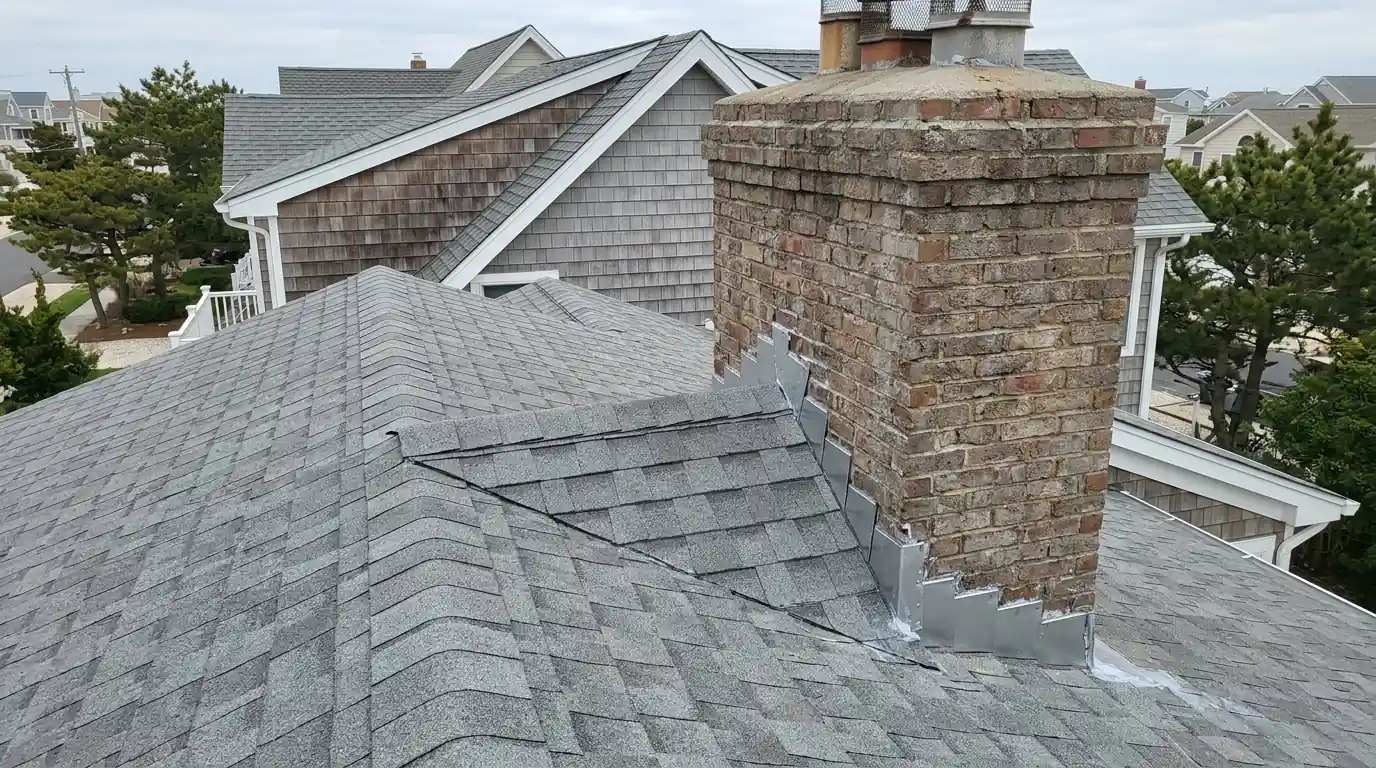
| Stain beside a chimney or on its wall | Step flashing, counter flashing, chimney crown | Masonry and metal move differently, and old sealant joints open up |
| Drips only in wind-driven rain from the east | Rake edges, ridge vent, siding-to-roof walls | Gusts off the bay push water sideways under laps that shed vertical rain fine |
| Water only after snow, along an outside wall | Eaves and the first few feet above the gutter | Ice dams back meltwater under shingles above the warm wall line |
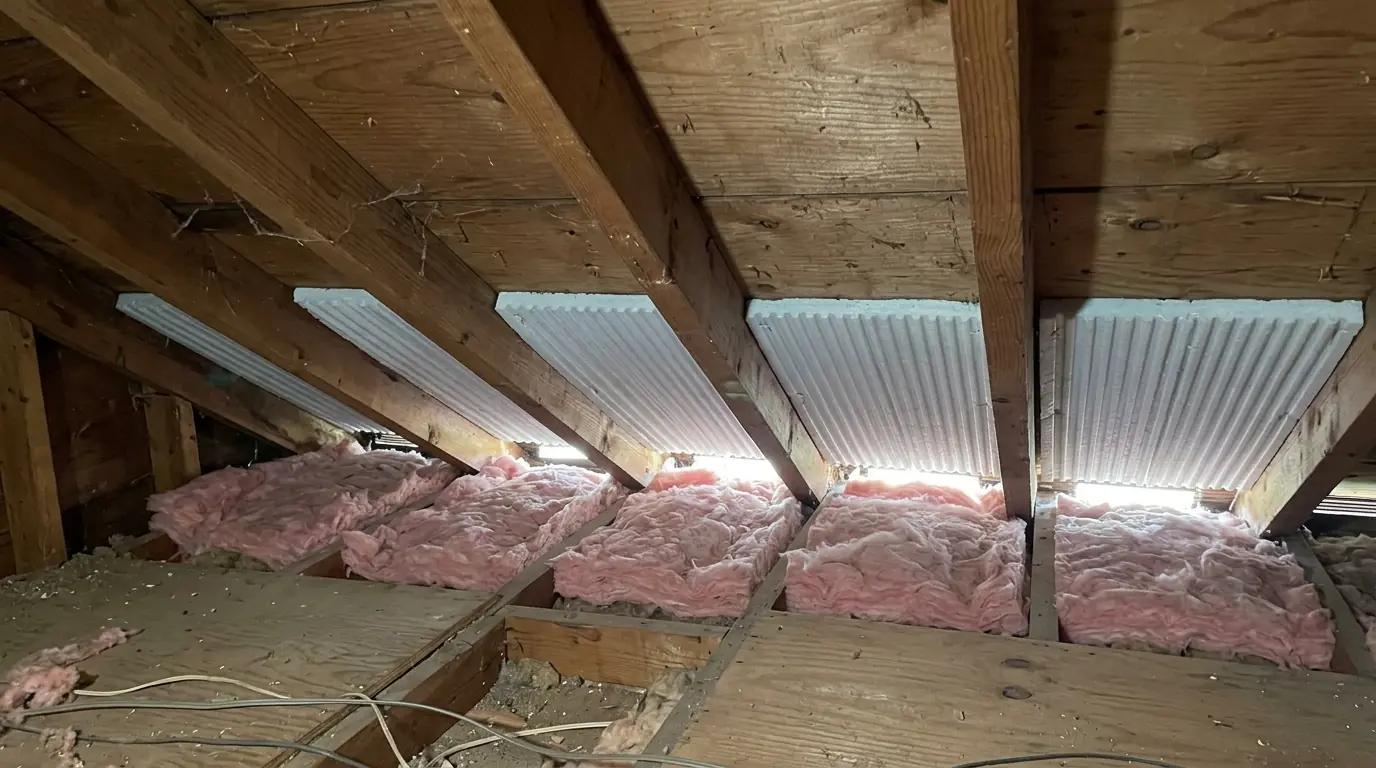
| Wet spots on a dry, cold morning | Attic ventilation and bath fan ducts | Warm moist air condenses on cold sheathing and drips, so no rain is involved |
| Ring around a skylight well | Skylight flashing kit and the glass seal | Older curb skylights rely on sealant that dries out, and fogged units may leak at the frame |
How we prove where the water comes in
A leak repair that skips diagnosis is a guess. This is the order we follow, and it's why we can tell you with confidence that the leak is fixed.
Map the stain from inside
We mark the stain, measure its distance from walls, and note nearby fixtures, vents and chimneys. That layout tells us which section of roof deserves the closest look.
10 to 15 minutesFollow the trail in the attic
With a flashlight and moisture meter, we follow dark wood, rusted nail tips and water lines uphill along rafters until we find the highest wet point. That is usually close to the true entry.
20 to 45 minutesInspect the roof surface above it
On the roof, we check every flashing, boot, fastener and lap in that zone. Lifted shingles, open sealant and torn underlayment show up clearly once we know where to look.
20 to 40 minutesRun a controlled water test
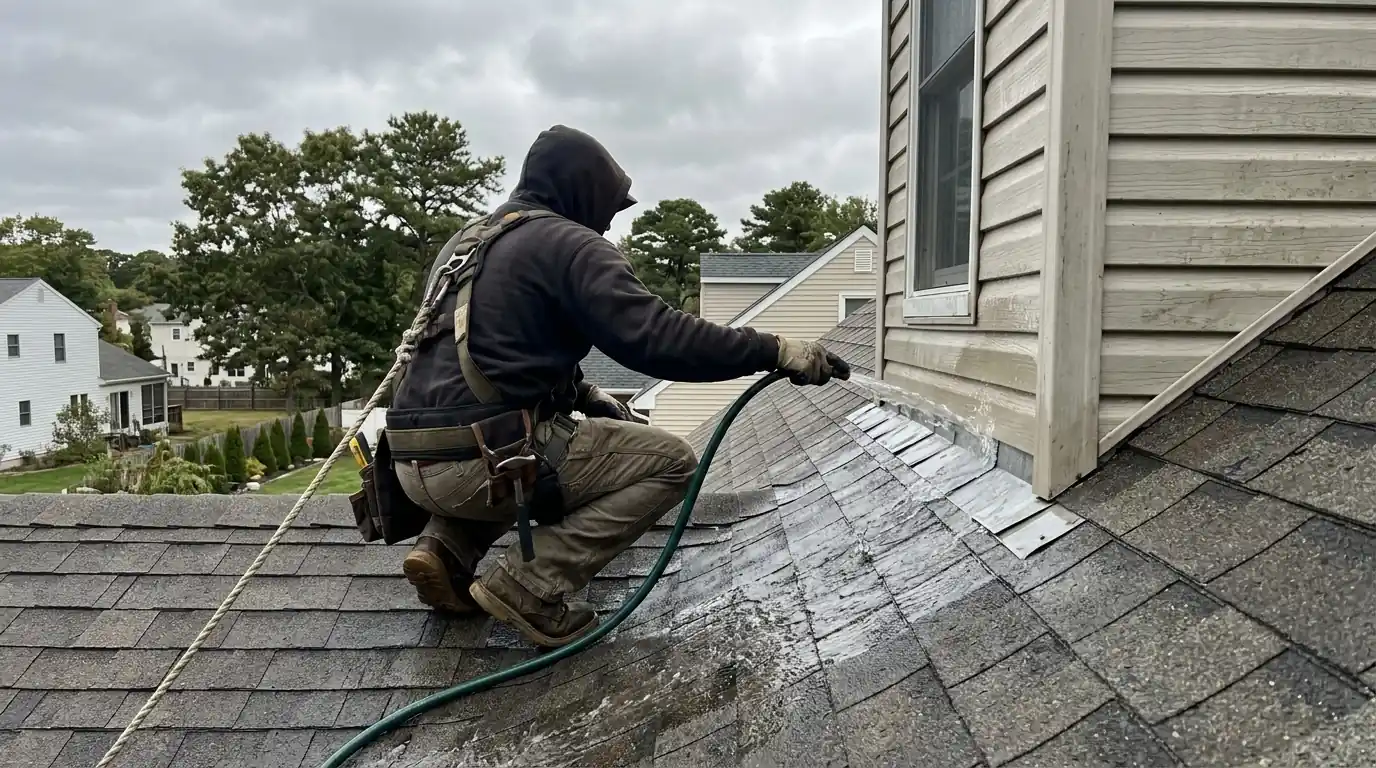
When the source isn't obvious, one person runs a hose on a single small area, starting low and working up, while another watches the attic. Water appearing inside points to the exact spot.
30 to 90 minutesRepair the entry, then retest
We fix the source with new flashing, boots or shingles, then run water over the same area again. A dry attic after the retest is the proof we look for before we call it done.
1 to 4 hours
The repairs that close most leaks
Once the source is proven, the fix is usually one of these. Sealant alone is never the whole answer.
New step and counter flashing
Where a roof meets a sidewall or chimney, we replace rusted or short step flashing piece by piece and set counter flashing over it. Lapped metal sheds water for decades, while a bead of caulk lasts a few seasons.
Replacement pipe boots
We swap cracked rubber collars for new boots, and on homes near salt air we often recommend all-metal or silicone collars, which hold up longer in strong sun than standard neoprene.
Ice and water barrier at problem edges
If ice dams caused the leak, we can open the lower courses and lay a self-adhered membrane such as GAF WeatherWatch along the eave before relaying shingles.
Resealed or reset skylights
An older skylight may only need a new flashing kit. If the frame is failing or the glass has fogged, a replacement unit with a matched kit from VELUX is usually the more lasting answer.
Corrected ventilation
When condensation is the cause, more roofing won't help. Balancing soffit intake and ridge exhaust, and routing bath fans outdoors, stops the drip at its source.
What leak repair usually runs in Ocean County
Most leak repairs fall in these ranges for 2026. Diagnosis is included in the visit when we do the repair.
| Work | Typical range | What moves the number |
|---|---|---|
| Leak trace with attic inspection and small fix | $395 to $940 | Attic access, roof height and whether a water test is needed |
| Replace a vent pipe boot and surrounding shingles | $310 to $620 | Boot material and how many courses must be lifted |
| Rebuild step flashing along one sidewall | $885 to $2,280 | Wall length and whether siding must be removed and reinstalled |
| Add ice barrier at a leaking eave section | $1,140 to $3,260 | Eave length, number of shingle courses removed and deck condition |
Your actual price depends on what we uncover once the area is opened, roof access and the materials on your home; we review it with you on site before work starts.
Why some leaks come back after a quick patch
The most common repeat leak we see is a sidewall or chimney that someone sealed with a tube of caulk instead of rebuilding the flashing. It holds for a winter, then the joint opens and water returns, often with rot underneath that wasn't there the first time. Chimneys get their own detailed approach on our chimney flashing page.
The other repeat offender is a leak blamed on the roof that is really condensation or ice. If water appears after cold snaps and not after rain, attic ventilation is likely part of the fix. Our article on ice dams and winter leaks walks through that pattern in more depth.
Why Toms River leaks often show up sideways
Rain at the Jersey Shore doesn't always fall straight down. During a nor'easter, wind off the ocean and Barnegat Bay drives water uphill under shingle laps, across ridge vents and into the joints where a roof meets a wall. Homes on the bay side, in places like Silverton and Bay Shore, often leak only during east and northeast winds, which is a strong clue in itself.
Our housing stock adds its own patterns. Capes and bi-levels from the 1950s through the 1970s have many roof-to-wall joints at dormers and half-stories, each one a flashing detail that can fail. Split-levels have short roofs tucked against taller walls. Humid summers and cold, damp winters push attic moisture high, so condensation drips get mistaken for roof leaks more often here than inland. On raised homes rebuilt after Sandy, longer vent stacks and new wall heights mean more boots and more step flashing to check.
Where we do this work most
We work across all of Toms River (08753, 08755 and 08757) and these neighboring towns every week, along with the rest of Ocean County and southern Monmouth County.
- Silverton, Toms River08753
- Pleasant Plains, Toms River08755
- West Dover, Toms River08755
- Ortley Beach, Toms River08751
- Lakewood08701
- Brick08723
- Jackson08527
- Howell07731
- Manchester08759
- Berkeley Township08721
- Lacey Township08731
- Stafford Township08050
- Barnegat08005
- Wall Township07719
- Freehold07728
- Point Pleasant08742