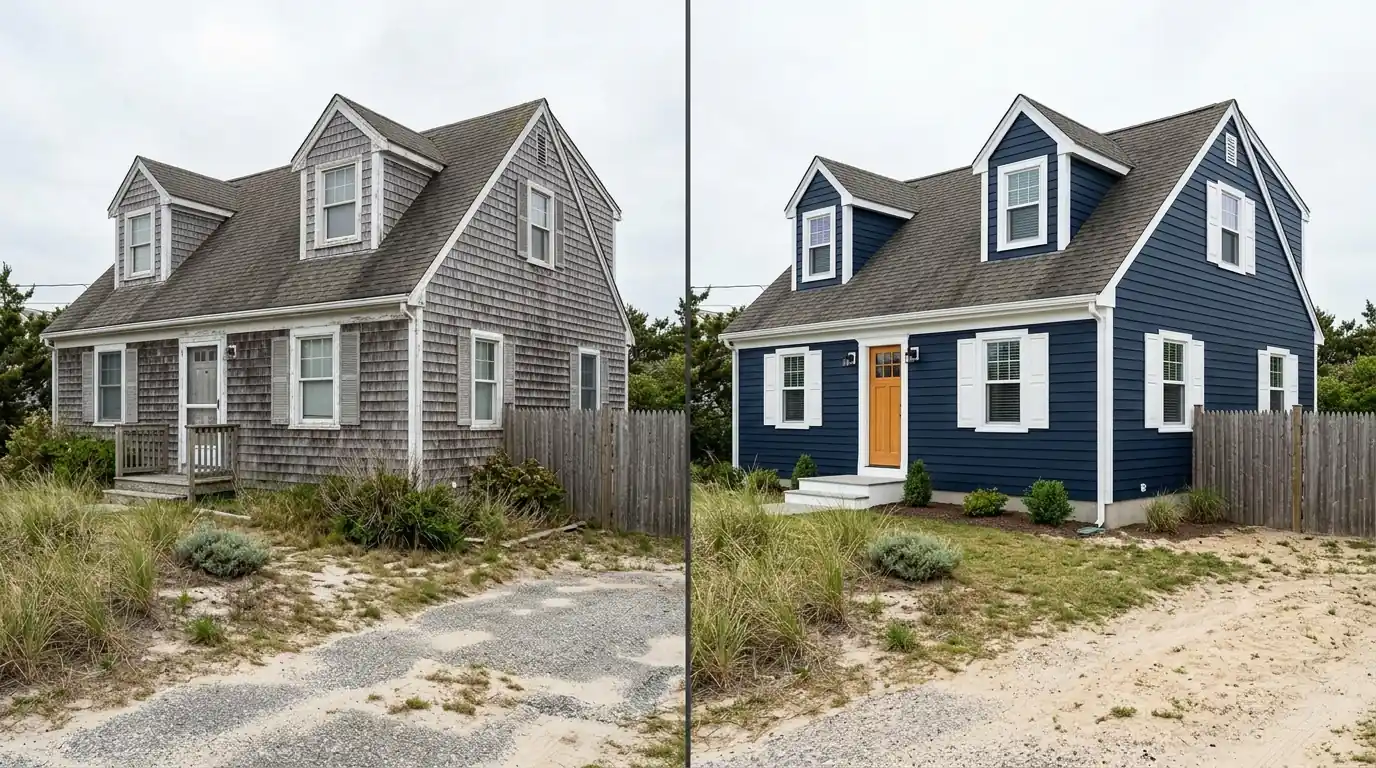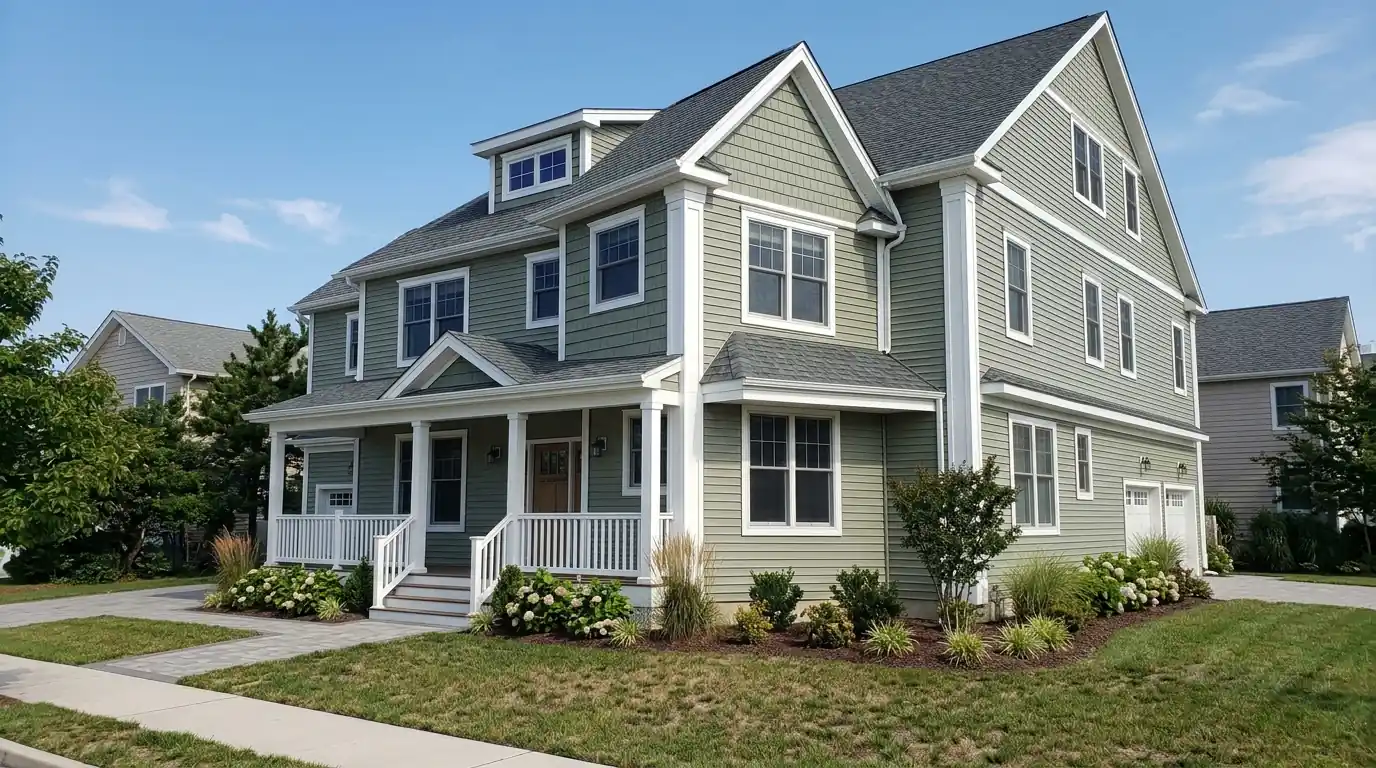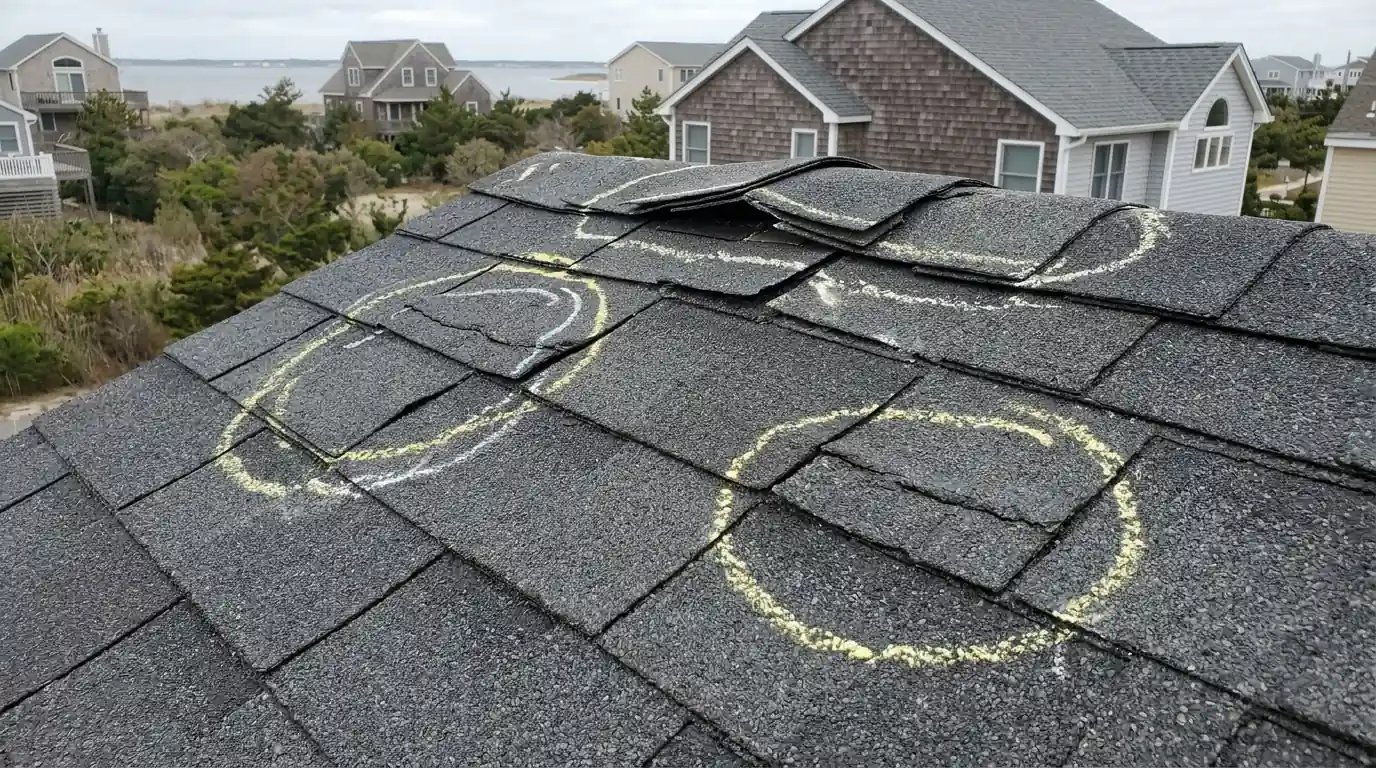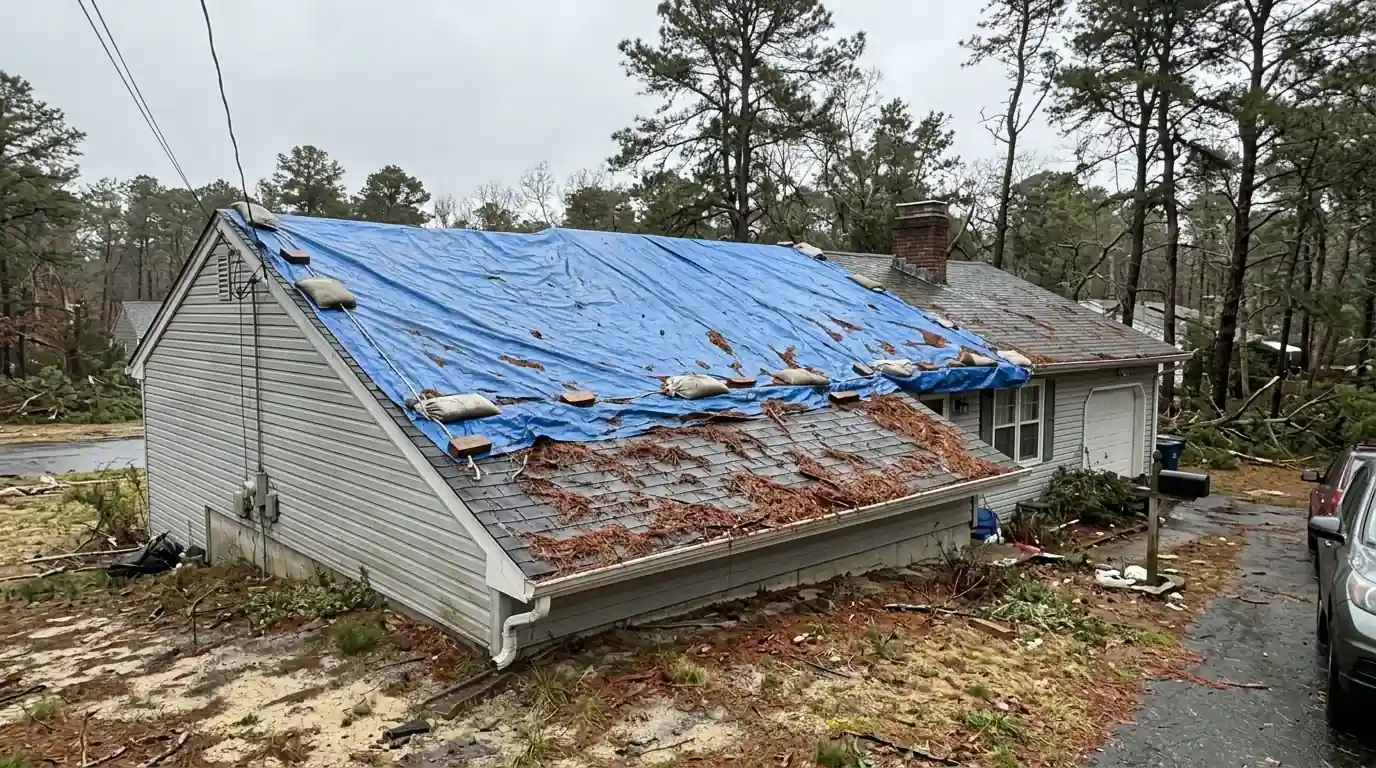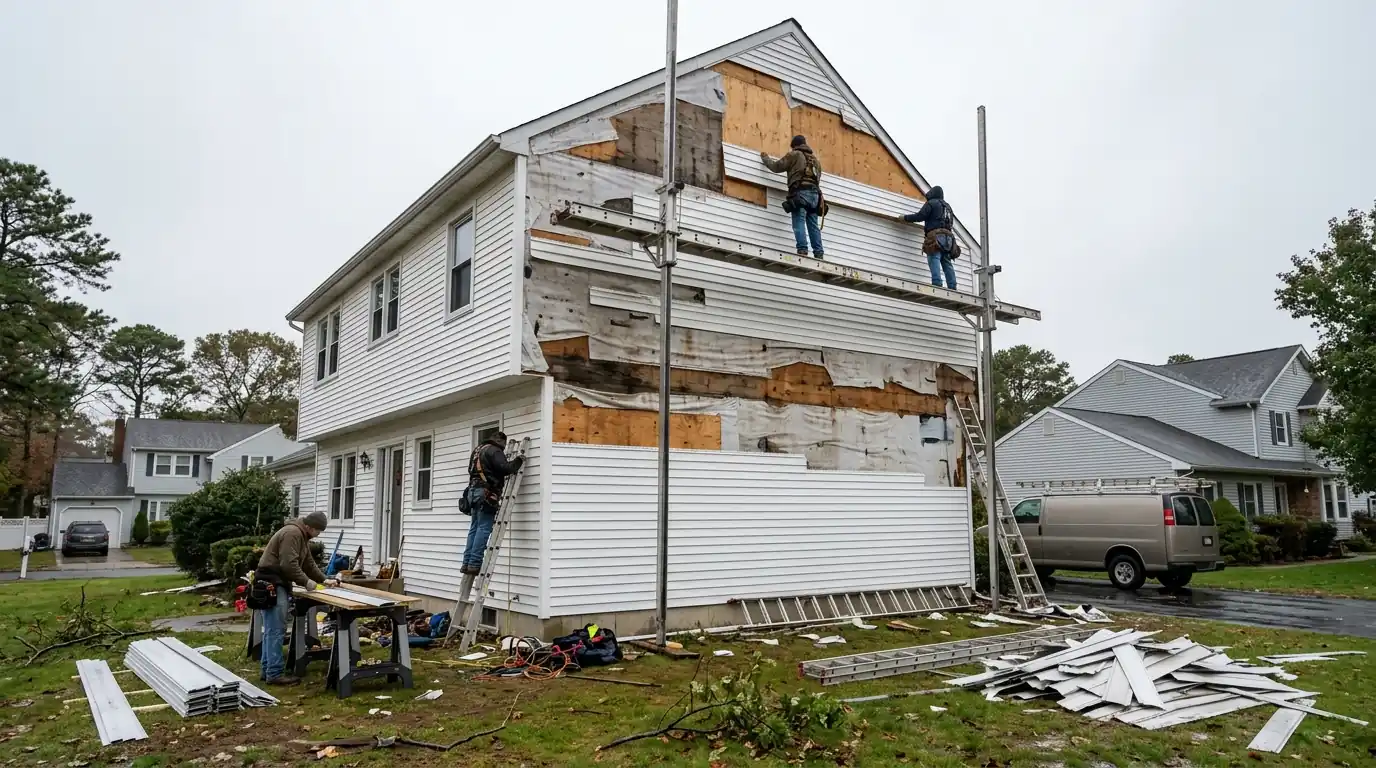
Most siding damage around Toms River can be repaired without re-siding the house. We replace the torn or cracked panels, relock loose courses and fix any wet sheathing behind them. The hard part is finding the same color and profile on older siding, and we have several ways to handle that. Call (732) 419-1462, any hour, if a wall is open to the weather.
Damage that shouldn't wait for good weather
Some siding problems are cosmetic. These let water into the wall, and every rain makes the repair bigger.
Panels torn off by wind
When courses blow off, the house wrap is often torn too, leaving bare sheathing exposed. Sheathing that stays wet for days swells, delaminates and starts growing mold inside the wall cavity.
Loose courses flapping in the wind
A panel that's unlocked from the one below will rattle and lift in every gust. Left alone, it pulls the next courses loose and eventually tears away, often taking corner trim with it.
Cracks and holes
Mower stones, hail, a falling limb or a cold-weather bump with a ladder can crack vinyl. Even a small hole lets wind-driven rain behind the siding, right where nobody can see it.
Melted or warped panels
Grills placed too close and sunlight reflected off a neighbor's windows can bend vinyl into ripples. Warped panels no longer lock tightly, so they shed water poorly and come loose easily.
Stains or soft spots below windows
Dark streaks under a window corner, or siding that flexes when you press it, usually mean water has been getting behind the trim for a while and the sheathing underneath is wet.
What happens when you call with a wall open to the weather
We answer the phone 24/7, and when wind has opened up a wall we send someone as fast as conditions safely allow. The first job is simple: keep water out. That usually means fastening heavy poly or a tarp over the exposed section, battened at the edges so the next gust can't peel it back, and taping any torn house wrap we can reach.
Inside, check the wall behind the damage. If drywall is damp or a window sill is wet, pull furniture away and let air move. We take photos of the damage before and after we cover it, which many homeowners find useful when they talk with their insurance company. Our post on documenting wind damage for a claim walks through what to photograph yourself.
If the roof took hits in the same storm, tell us when you call. Shingles and siding often fail together on the windward side, and our storm damage roof repair work can be done on the same visit.
How we make a permanent siding repair
Once the wall is protected, the permanent repair is usually a single visit. Finding the right material is what sets the timeline.
Assess how far the damage runs
We release the courses above the damaged area with a zip tool and look behind them. Wind damage often extends a panel or two past what's visible, and water may have traveled further down the wall.
20 to 40 minutesIdentify and match the siding
We note the profile, exposure, thickness and color, and check for a stamped product line on the back. Then we search current lines and supplier stock for the closest match available.
1 to 5 days for materialRepair the sheathing and wrap
Soft or delaminated sheathing gets cut out and replaced. New house wrap is lapped under the existing wrap above and over the wrap below, and tears are taped so water drains outward.
1 to 3 hoursInstall and lock the new panels
Replacement panels are nailed through the center of the slots with room to move, then locked into the courses above and below. Corner posts and J-channel get replaced if they were bent.
1 to 4 hoursCheck the rest of the wall
Before we leave, we press along nearby courses to find any other unlocked panels and refasten them. Any damage you missed from the ground gets photographed and shown to you.
15 to 30 minutes
What siding repairs typically cost near Toms River
Repairs are priced by the amount of siding and what's behind it. These 2026 ranges reflect common jobs across Ocean County.
| Work | Typical range | What moves the number |
|---|---|---|
| Emergency cover-up of an open wall | $285 to $740 | Size of the opening, height and time of day |
| Replacing a few vinyl panels on a first-floor wall | $375 to $980 | Number of panels, how rare the profile is and trim involved |
| Re-siding one damaged gable or wall section | $1,640 to $4,870 | Height, staging, profile and whether the match is close enough |
| Sheathing and wrap repair behind siding | $310 to $1,280 | How far water traveled and how much sheathing is soft |
| Fiber cement plank replacement and touch-up paint | $460 to $1,350 | Plank count, finish color and how closely the paint must blend |
Prices vary with every house and every storm. Treat these as general ranges, not quotes.
How we deal with siding that's no longer made
This is the question we hear most. A lot of the vinyl on Toms River homes went up in the 1990s and early 2000s, and many of those colors and profiles have since been discontinued. Even when the line still exists, twenty summers of sun will have faded your siding a few shades from a new carton.
We have a few honest options. First, we look for an exact or very close current match from makers such as Alside, Mastic or CertainTeed. If the color is off, we can borrow panels from a hidden wall, like the back of a garage or behind a fence, use them on the visible damage and put new panels where they won't be noticed. When neither works, the cleanest answer is to re-side a whole wall or gable, ending at a corner so the change in color reads as intentional.
If several walls are damaged, or the siding is brittle and cracking all over, repair stops making sense. Our siding replacement page covers re-siding the full house.
Why Ocean County siding takes so much wind damage
Nor'easters hit Toms River from the northeast across open water, and the gusts find any loose panel. Gable ends and the upper walls of two-story colonials catch the strongest wind. On the barrier island in Ortley Beach and Normandy Beach, homes raised after Sandy now stand well above their neighbors' rooflines, so their siding sees wind that ground-level homes never did.
Inland neighborhoods have their own risks. The pitch pines and oaks around Pleasant Plains and Cedar Grove drop limbs onto walls in storms, and summer thunderstorms bring hail that cracks cold, brittle vinyl the following winter. Many 1970s and 1980s bi-levels and ranches carry siding that's become brittle with age, so it cracks instead of bending. We also see a lot of damage under windows on older capes, where the original flashing was minimal and water has been running behind the trim for years before anyone notices the stain.
Where we do this work most
We work across all of Toms River (08753, 08755 and 08757) and these neighboring towns every week, along with the rest of Ocean County and southern Monmouth County.
- Silverton, Toms River08753
- Pleasant Plains, Toms River08755
- West Dover, Toms River08755
- Ortley Beach, Toms River08751
- Lakewood08701
- Brick08723
- Jackson08527
- Howell07731
- Manchester08759
- Berkeley Township08721
- Lacey Township08731
- Stafford Township08050
- Barnegat08005
- Wall Township07719
- Freehold07728
- Point Pleasant08742