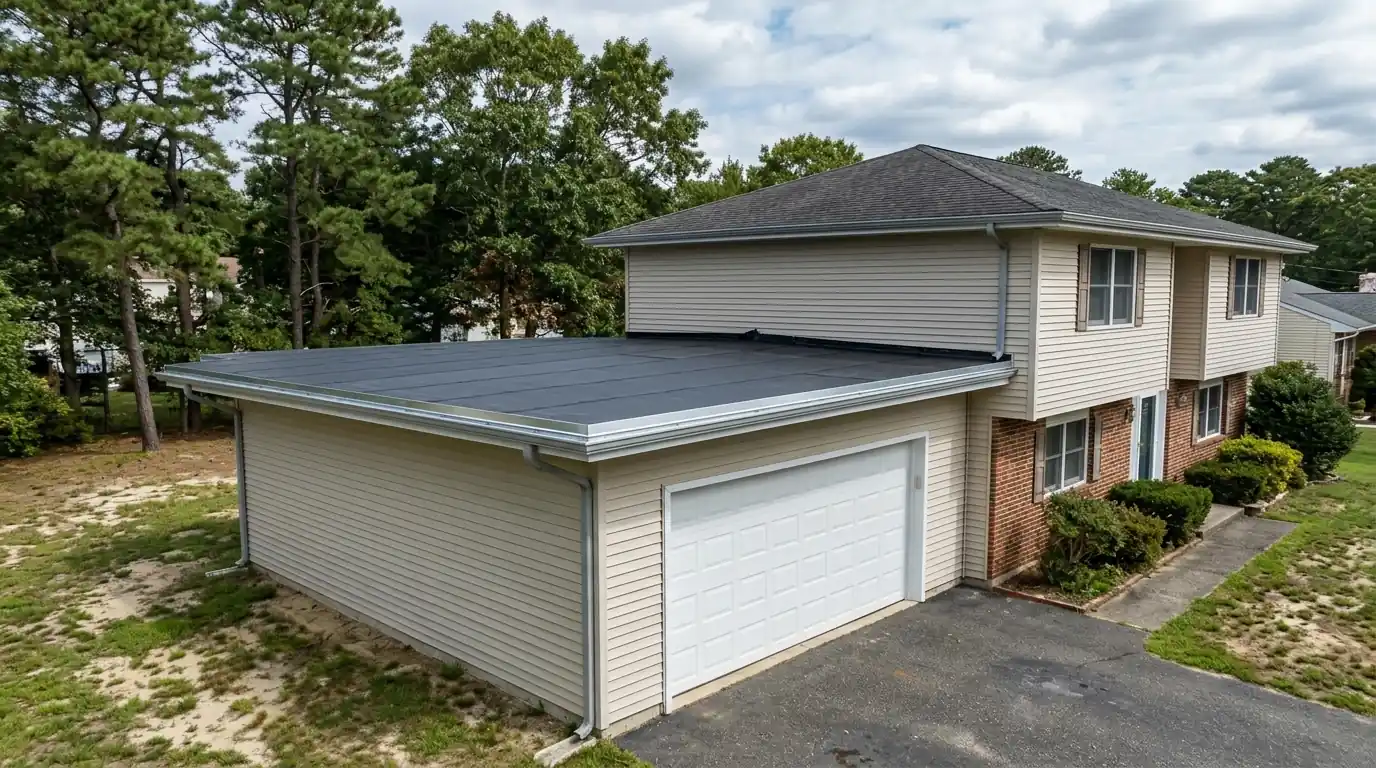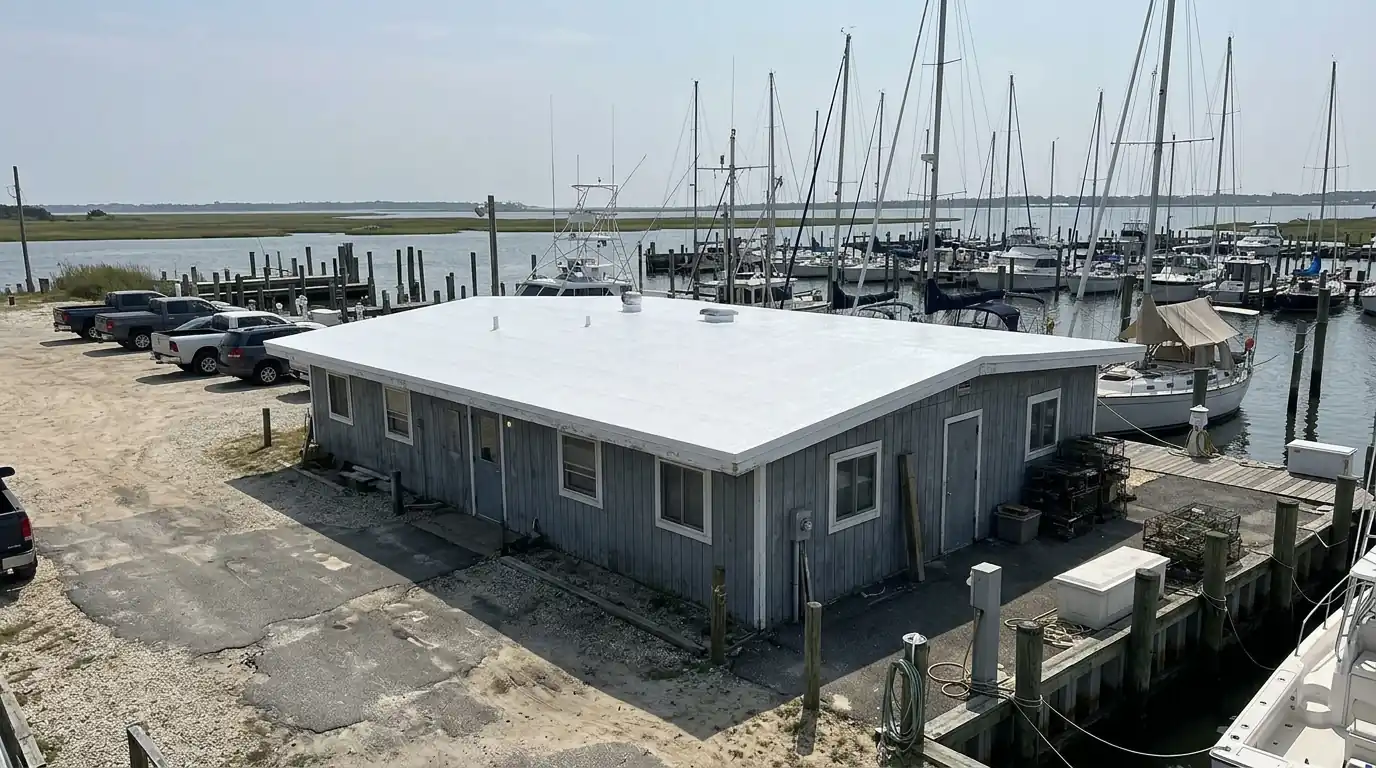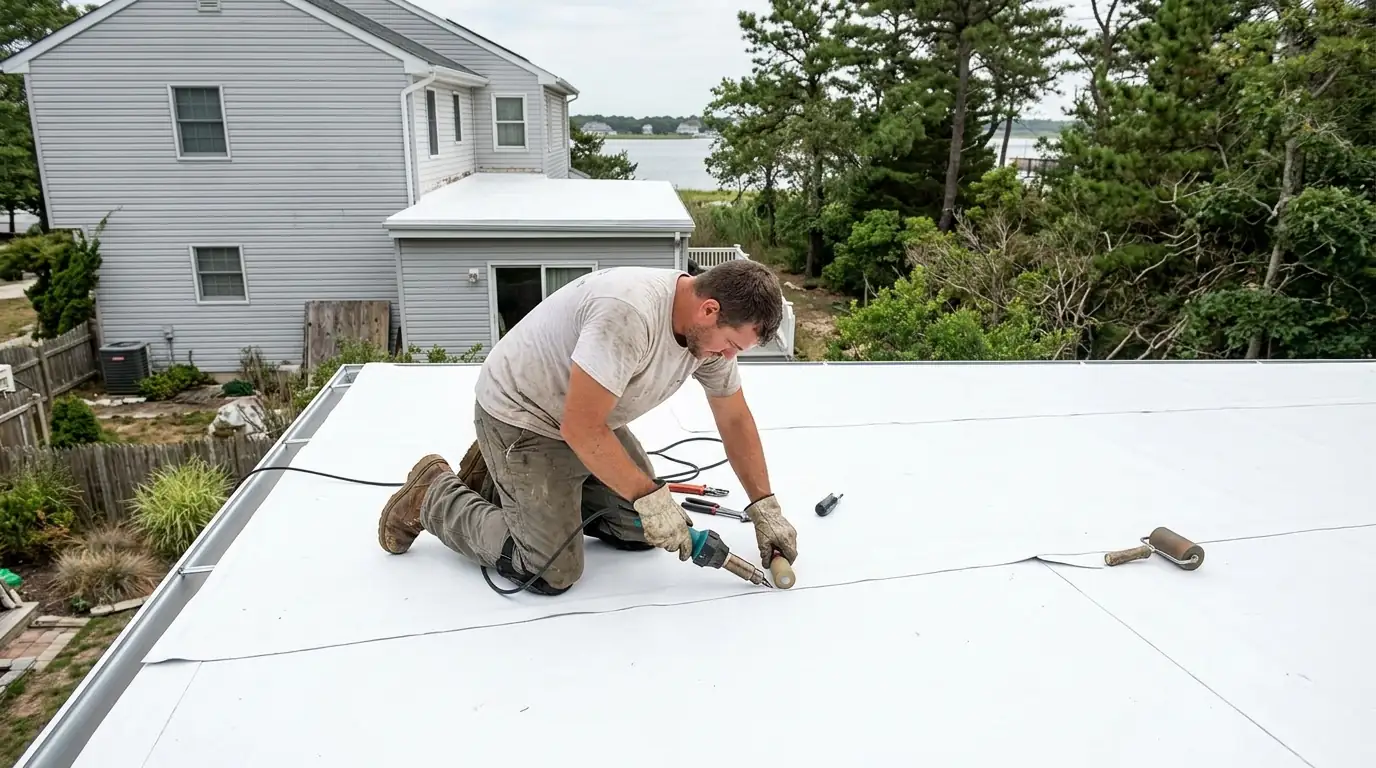
TPO is a single-ply white membrane whose seams are melted together with hot air, so the whole roof becomes one continuous sheet. Around Toms River it's a strong pick for flat roofs on additions, porches, garages and small commercial buildings. Most residential sections take one to two days. Give us a call at (732) 419-1462 and we'll measure and talk through options.
TPO, rubber or modified bitumen: which flat roof fits your house
Three membranes cover most of the flat roofs we see in Ocean County. Each has a place, and the right one depends on sun, shade, foot traffic and what's on the roof now. If you're leaning toward rubber, our EPDM rubber roofing page covers that side in detail.
| Membrane | How the seams join | Where it fits best |
|---|---|---|
| TPO (thermoplastic polyolefin) | Hot-air welded into one continuous sheet | Sunny roofs, rooms below that run hot, roofs that see regular service traffic |
| EPDM (rubber) | Primer and seam tape, or adhesive | Small dormers and porches with simple shapes, roofs shaded most of the day |
| Modified bitumen | Torch-applied or self-adhered laps | Low-slope sections tied into shingles, where a granulated surface blends in better |
| Coating over the existing membrane | No seams, sprayed or rolled on | Sound roofs with dry insulation that need more years rather than a new system |
What sits under the membrane decides how long it lasts
A TPO sheet is only as good as the layers beneath it and the metal around it. These are the parts we spend the most time on, because they're where flat roofs usually give out first.
Tapered insulation
Polyiso board cut with a built-in slope moves water toward a scupper or drain. On a dead-flat deck that's the difference between a roof that drains within an hour and one that holds puddles for days.
Cover board
A thin, dense board over the insulation gives the membrane a hard surface. It resists dents from ladders and dropped tools, and it keeps foot traffic from crushing the foam underneath over the years.
Adhered or fastened
Fully adhered TPO stays quiet in high wind and suits small residential roofs. Mechanically fastened systems use plates and screws hidden under the seam laps, which works well across larger commercial decks.
Edge metal
Wind peels a flat roof from the perimeter first. We set heavier gauge edge metal, cover the flange with welded TPO strips, and choose a finish color that sits well with your fascia and trim.
Scuppers and drains
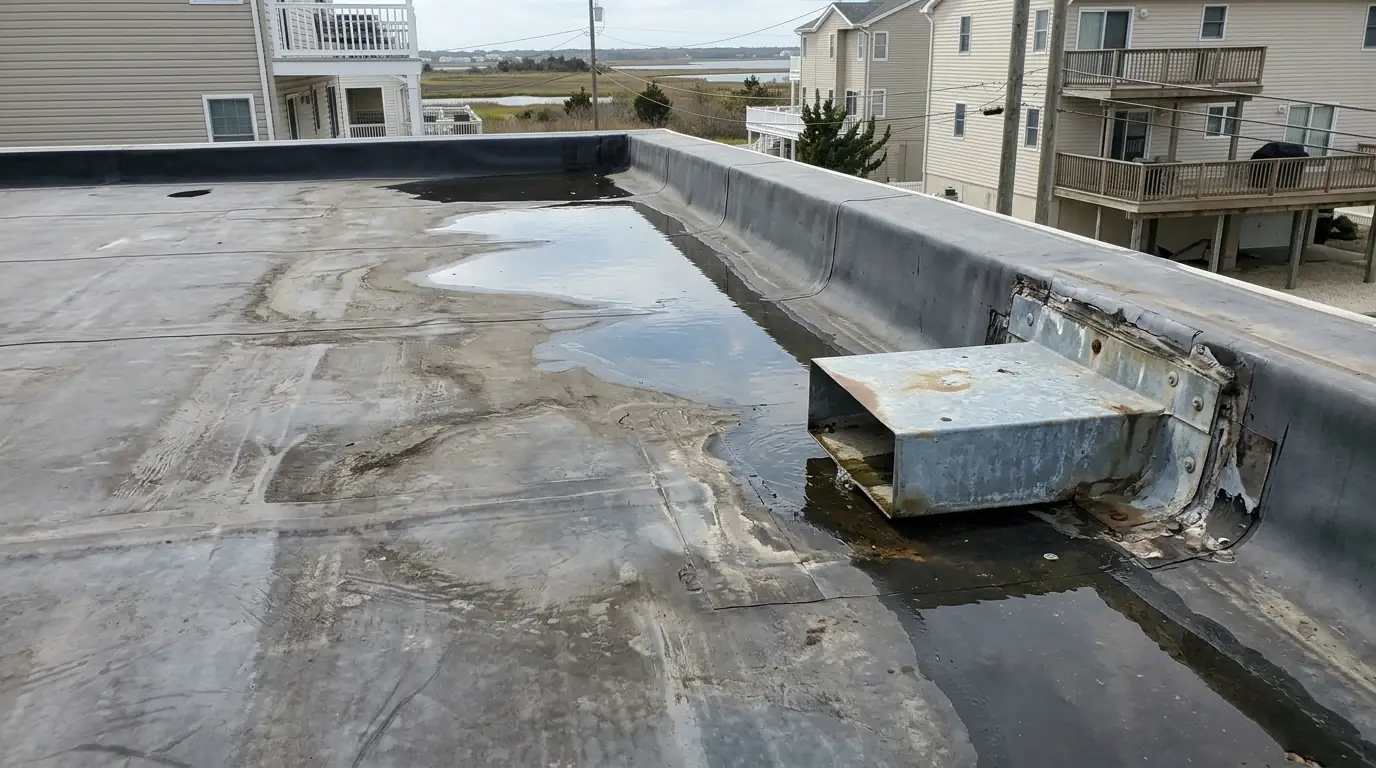
Through-wall scuppers on older additions often rust or crack where they meet the siding. We replace them with TPO-clad or aluminum units sized to the downspout below so water leaves quickly.
Wall and door upturns
Where a flat roof meets a sliding door or a second-story wall, the membrane turns up the wall and tucks behind the siding. That upturn is where many of the flat roof leaks we trace begin.
How a new TPO roof goes on
Most residential flat sections take one to two working days. Larger commercial decks run longer, but the order of work stays the same.
Core the old roof
We cut a small test core to see how many layers are already there and whether the insulation is wet. That one sample tells us whether a recover is possible or a full tear-off makes more sense.
First visit, about an hourTear off and open the deck
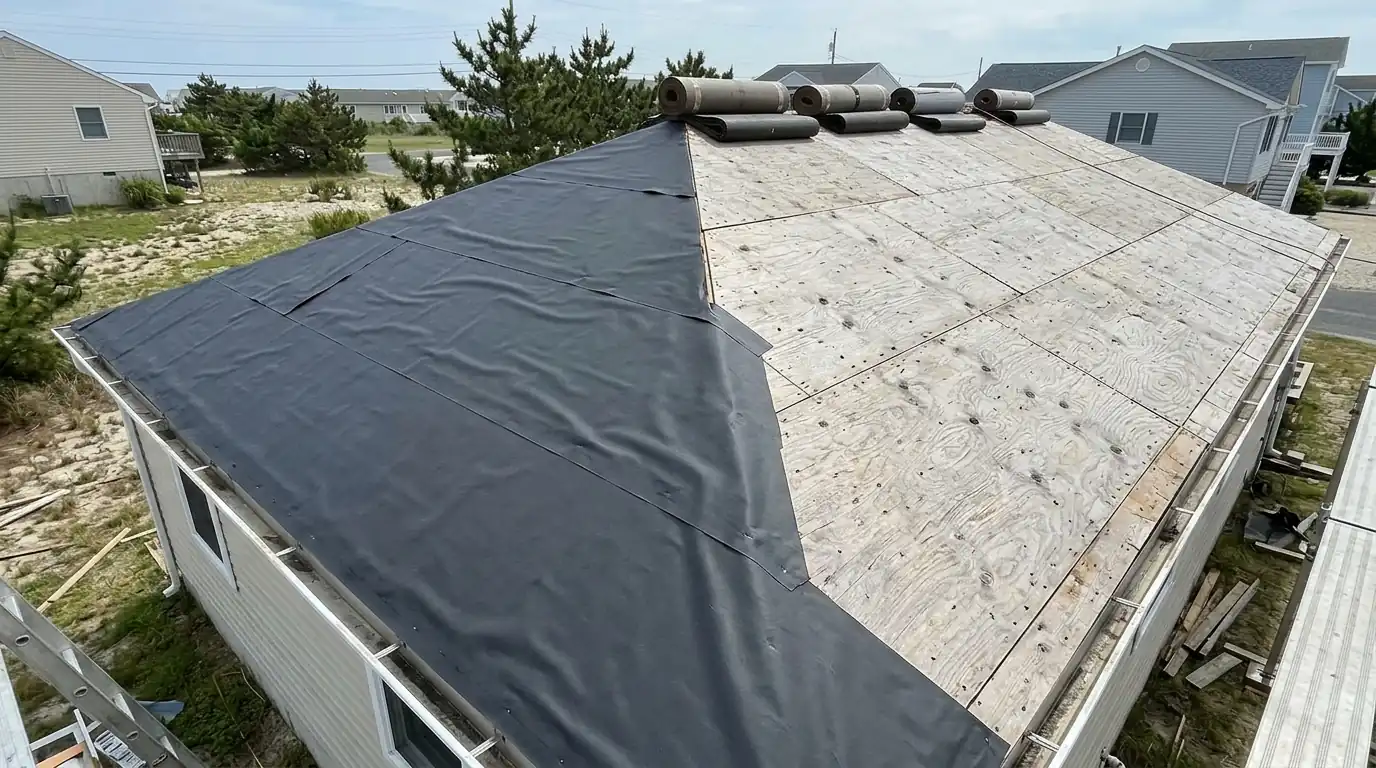
Old membrane, soggy insulation and loose debris come off. We check every plywood sheet and plank, replace soft spots before anything new goes down, and dry the deck in if weather turns late in the day.
Day 1, morningSet insulation and cover board
Tapered polyiso goes down to build slope, followed by the cover board. Both are fastened or adhered the way the membrane maker's instructions call for on that particular system.
Day 1, afternoonRoll out and weld the sheet
The TPO is adhered, then every lap is heat-welded with an automatic or hand welder. We drag a blunt probe along each seam afterward to find any spot that didn't fuse completely.
Day 2, morningFlash walls, curbs and pipes
Pipe boots, skylight curbs, condenser stands and wall upturns get prefabricated or field-cut TPO flashings welded in place. Termination bar and edge metal finish off the perimeter.
Day 2, afternoonWater test and clean up
We run a hose across the roof and watch the drains and scuppers work. The yard gets a magnet sweep for screws and plates, and you get photos of the finished seams.
End of day 2
What a TPO roof costs around Toms River
These are typical 2026 ranges for Ocean County. Your number depends on size, how many layers come off, how much slope we build in, and how many pipes and curbs pass through the roof.
| Work | Typical range | What moves the number |
|---|---|---|
| Porch or sunroom roof, up to about 250 sq ft | $3,180 to $5,960 | Tear-off layers, wall flashing at the house |
| Garage or addition, 250 to 600 sq ft | $5,740 to $11,380 | Tapered insulation, number of penetrations |
| Roof deck over living space on a raised home | $8,260 to $16,940 | Railing posts, door thresholds, walkway pads |
| Small commercial deck, per square foot | $8.70 to $14.40 | Fastened or adhered, drains, rooftop units |
| Replacing rotted plywood under the membrane | $94 to $168 per sheet | How much decking is soft once it's open |
These ranges are general guidance, not a quote. We give you a written price after we've measured the roof and seen what's under the old covering.
Why a white flat roof changes how a room feels in July
White TPO reflects much of the sunlight a black rubber or dark granulated roof would soak up. On a south-facing addition or a sunroom with a flat roof, you notice that in the room below. The ceiling stops radiating heat at four in the afternoon, and the air conditioner cycles less often during humid August stretches.
Brightness fades a bit as dust and pollen settle on the surface, which is normal. A rinse with a garden hose each spring brings most of it back. Gray and tan sheets are also made for homes where a glaring white roof would be visible from a bedroom window and you'd rather it blend in.
Carlisle, GAF and Johns Manville each make TPO in several thicknesses. On homes we usually lean toward 60 mil, which puts more material over the reinforcing scrim than the thinner 45 mil sheet and holds up better to the occasional dropped tool.
A few things to sort out before your TPO job starts
None of these take long, and settling them ahead of time keeps the work moving once we arrive.
- Clear patio furniture, grills and planters off any roof you walk out onto
- Tell us about rooftop condensers or mini-split line sets so they can be lifted and reset
- Move cars from the driveway if the dumpster needs to sit there
- Point out any ceiling stains below the flat section, even old ones
- Mention a fogged or cracked skylight on that roof, since skylight replacement is easiest while the membrane is off
- Pick white, gray or tan membrane
- Keep pets inside on tear-off day, when noise and debris peak
Flat roofs between Barnegat Bay and the ocean
Low-slope roofs around Toms River show up in a few predictable places: shed-roof additions put on 1960s and 1970s ranches, flat garage roofs on split-levels, and the rooftop decks and low sections on homes raised after Hurricane Sandy. All of them sit in steady bay wind, and out on the barrier island in Ortley Beach the air carries enough salt to corrode cheap fasteners and edge metal within a few seasons.
That's why we use coated or stainless fasteners near the water and weld TPO strips over every metal edge. Nor'easters drive rain sideways across a flat roof, so we build slope toward the drain side wherever the framing allows. Inland, pine needles clog scuppers fast, and a blocked scupper turns into standing water within a single storm. A screened scupper box helps more than most homeowners expect, and it's a small add-on during installation.
Where we do this work most
We work across all of Toms River (08753, 08755 and 08757) and these neighboring towns every week, along with the rest of Ocean County and southern Monmouth County.
- Silverton, Toms River08753
- Pleasant Plains, Toms River08755
- West Dover, Toms River08755
- Ortley Beach, Toms River08751
- Lakewood08701
- Brick08723
- Jackson08527
- Howell07731
- Manchester08759
- Berkeley Township08721
- Lacey Township08731
- Stafford Township08050
- Barnegat08005
- Wall Township07719
- Freehold07728
- Point Pleasant08742