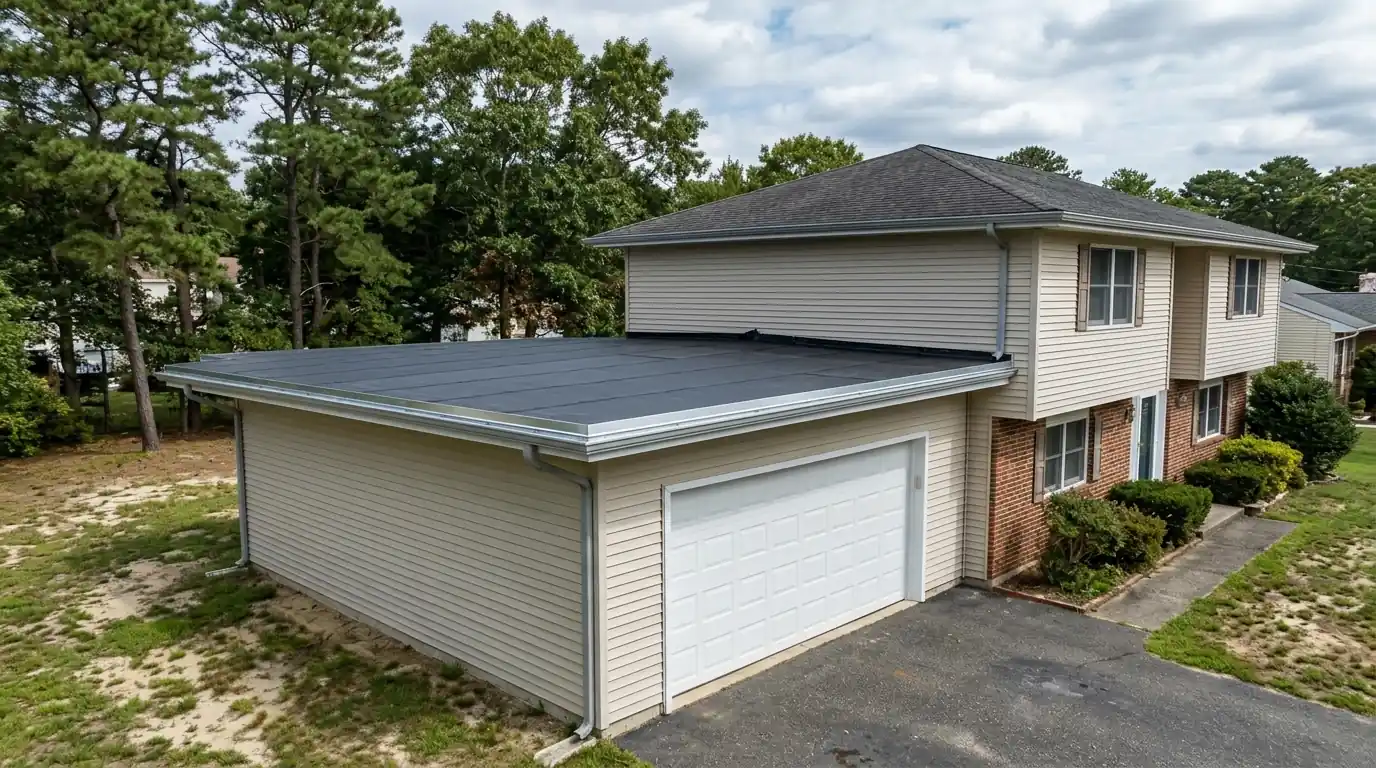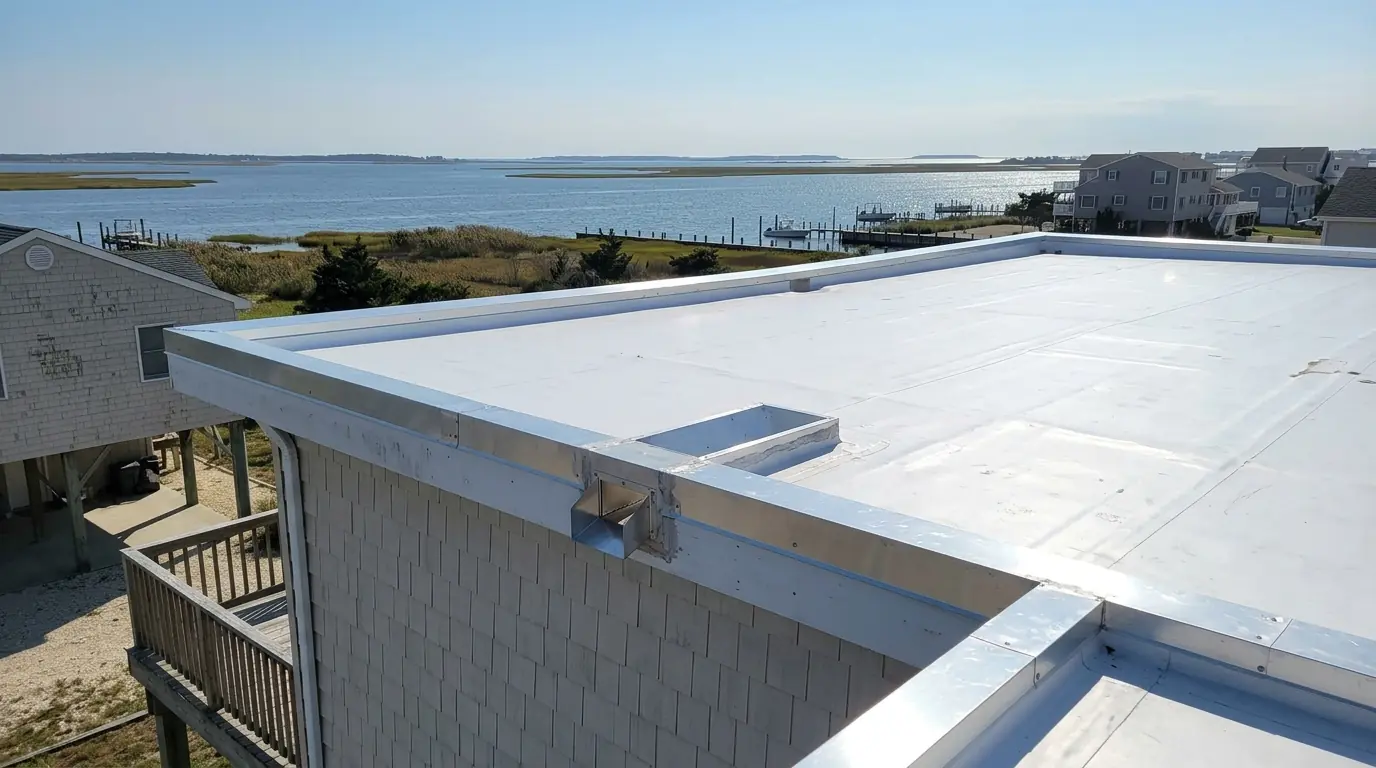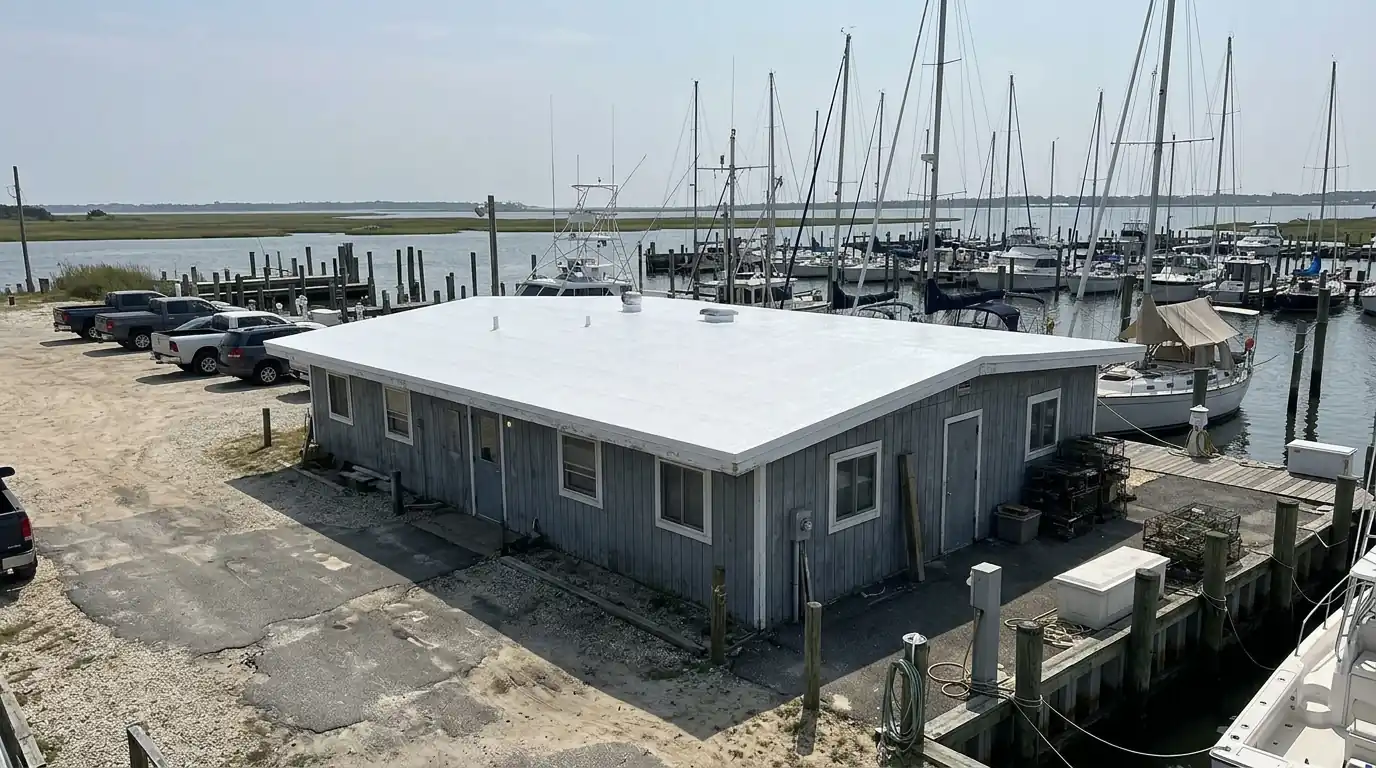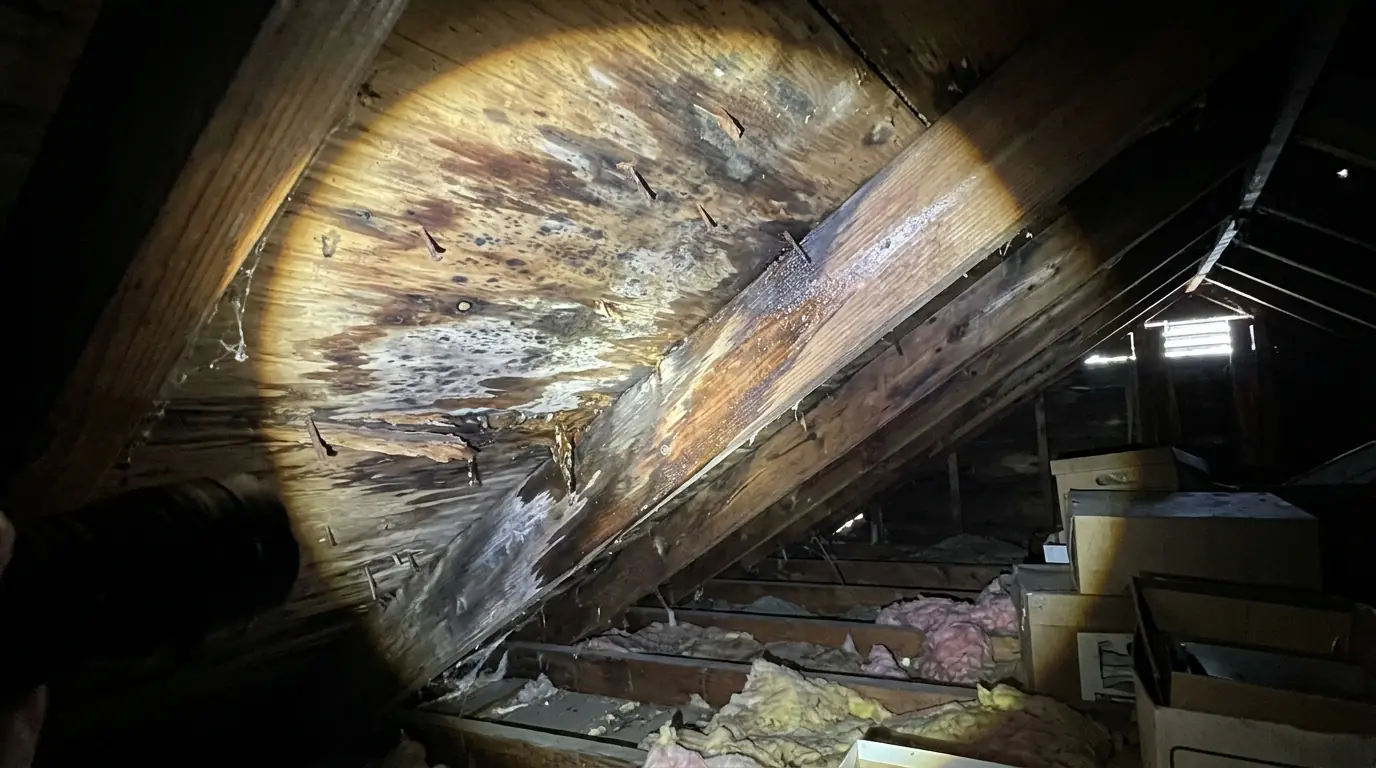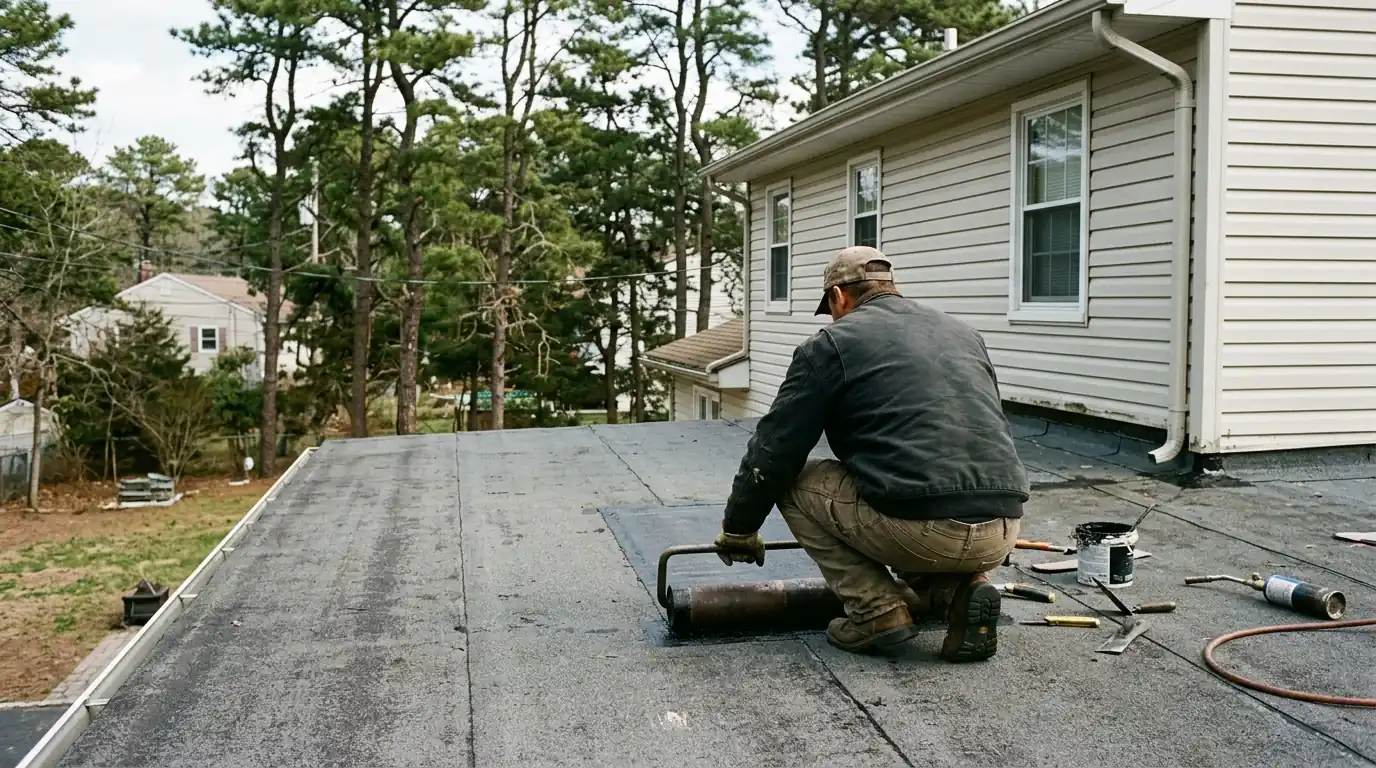
Most flat roof leaks in Toms River come from split seams, blistered or cracked modified bitumen, punctures, and scuppers or drains that clog and let water pond. Repair means cleaning and patching the membrane with a compatible material, then fixing whatever is holding water. We work on modified bitumen, EPDM and TPO. Call (732) 419-1462.
Warning signs on a low-slope roof
Flat roofs give plenty of warning if someone looks up there. These are the problems we find most often during a repair visit.
Ponding that lingers for days
Small puddles that dry within a day or two are common. Water that stays longer adds weight, wears the surface and finds any weak seam. It usually points to a sagging deck or a blocked drain.
Blisters and bubbles
Air or moisture trapped between layers of modified bitumen swells in the sun into raised bubbles. Intact blisters can be watched, but cracked ones let water straight into the layers below.
Open or lifting seams
Seams are where sheets overlap. On EPDM the seam tape can let go, on modified bitumen the lap can curl. Either way, water creeps sideways underneath and travels a long way before it drips.
Cracking and alligatoring
Surfaces that dry out under strong sun develop a pattern of cracks like reptile skin. On older roll roofing and coated surfaces, that's often the first sign the top layer is wearing through.
Clogged scuppers and drains
Leaves, pine needles and grit from nearby shingle roofs collect at scuppers and drain grates. When they block, water backs up and rises above flashing heights it was never meant to reach.
Soft spots underfoot
A spongy feel when walking means the insulation board or deck below is wet. That moisture keeps spreading under the membrane until the wet material is cut out and replaced.
What to do when a flat roof starts dripping
If you see water inside under a porch roof, sunroom or addition, start by checking the scupper or drain if you can reach it safely from a ladder at the edge. A clump of leaves pulled out of a scupper sometimes drains a pond in minutes and stops the drip on the spot. Don't walk out onto a soft, wet roof, and don't puncture blisters.
Then give us a call at (732) 419-1462. Flat roof leaks often show up some distance from the actual opening, because water travels under the membrane before it finds a seam in the deck. If the roof is badly opened by wind or a limb, our emergency tarping visit covers it until we can make a proper repair.
How we repair a low-slope roof the right way
The key to a lasting flat roof repair is using a material that bonds to what's already there and fixing why the damage happened.
Identify the membrane
Modified bitumen, EPDM rubber and TPO each need their own repair materials. Patching rubber with asphalt cement, for example, can damage the membrane. We confirm the type before buying anything.
10 minutesFind wet areas and the entry
We look for ponding marks, open seams and punctures, probe soft areas and check flashing at walls, curbs and edges. On larger roofs, a moisture meter maps how far wet insulation has spread.
30 to 60 minutesClean and prepare the surface
Repair areas get cleaned of dirt, oxidation and old coatings. EPDM is primed for new seam tape, TPO is cleaned for welding, and modified bitumen is cut back to sound material around blisters or splits.
30 to 90 minutesPatch, weld or reseal
We apply a properly sized patch of the same material, with rounded corners and full adhesion. TPO patches are heat welded, EPDM uses cover tape and modified bitumen is torched or self-adhered.
1 to 3 hoursFix drainage and edges
Clogged scuppers are cleared, failed scupper boxes and drain flashings are rebuilt, and loose edge metal is refastened. If a deck sag is causing ponding, we explain what correcting it involves.
1 to 3 hours
Typical flat roof repair costs near Toms River
Low-slope repairs run in these 2026 ranges on homes and small buildings in Ocean County. Larger commercial roofs are priced on their own.
| Work | Typical range | What moves the number |
|---|---|---|
| Patch a puncture or small split | $385 to $960 | Membrane type, access and how many patches are needed |
| Reseal a failed seam run | $640 to $1,780 | Seam length, membrane type and condition of the surrounding sheet |
| Cut out wet insulation and patch | $1,260 to $3,840 | Size of the wet area and the insulation and deck replaced |
| Rebuild a scupper or drain flashing | $575 to $1,490 | Scupper size, conductor head and downspout tie-in |
| Recoat an aging modified bitumen roof | $1,980 to $4,860 | Roof size, prep work and coating chosen |
Prices depend on the roof size, the membrane, access and how much wet material we find once the roof is opened; we confirm the scope with you on site.
A five-minute habit that saves flat roofs
Most of the low-slope leaks we repair start at a drain or scupper choked with needles, leaves and shingle grit. If you can reach the edge of your porch or addition roof safely from a ladder, pull debris out of the scupper opening each spring and fall and after big storms. Don't step onto the membrane itself. If water is still standing two days after rain, or you can't reach the drain safely, give us a call and we'll clear it and check the seams while we're up there.
When repairs stop making sense on a flat roof
Low-slope roofs age differently from shingles. Once a modified bitumen roof is cracked across most of its surface, or more than a small share of the insulation is wet, patching becomes a cycle of chasing leaks. At that point a new membrane is usually the better value.
For many porches, dormers and additions, a fully adhered EPDM roof from a maker like Carlisle is a good long-term choice. Larger roofs, or roofs where summer heat is a concern, may suit a white TPO membrane better. We'll explain both, with photos of your current roof, so you can decide.
Low-slope roofs around Toms River and the barrier island
Flat and low-slope roofs are everywhere in our service area, even if they're not the main roof. Ranches and bi-levels often have a later addition or enclosed porch under a low-pitch section. Many raised homes in Ortley Beach and along the bay lagoons have flat decks and roof terraces over living space. Strip shops and offices along Route 37 and Hooper Avenue often run on aging modified bitumen or rubber.
The shore climate is hard on all of them. Summer sun bakes the surface and wears out coatings faster. Nor'easters push wind-driven rain across flat roofs and up under edge metal, and heavy downpours can overwhelm a single small scupper in minutes. Pine needles from the surrounding woods clog drains fast. Salt air on the barrier island corrodes older galvanized edge metal and drain parts, so we usually suggest aluminum or coated replacements.
Where we do this work most
We work across all of Toms River (08753, 08755 and 08757) and these neighboring towns every week, along with the rest of Ocean County and southern Monmouth County.
- Silverton, Toms River08753
- Pleasant Plains, Toms River08755
- West Dover, Toms River08755
- Ortley Beach, Toms River08751
- Lakewood08701
- Brick08723
- Jackson08527
- Howell07731
- Manchester08759
- Berkeley Township08721
- Lacey Township08731
- Stafford Township08050
- Barnegat08005
- Wall Township07719
- Freehold07728
- Point Pleasant08742