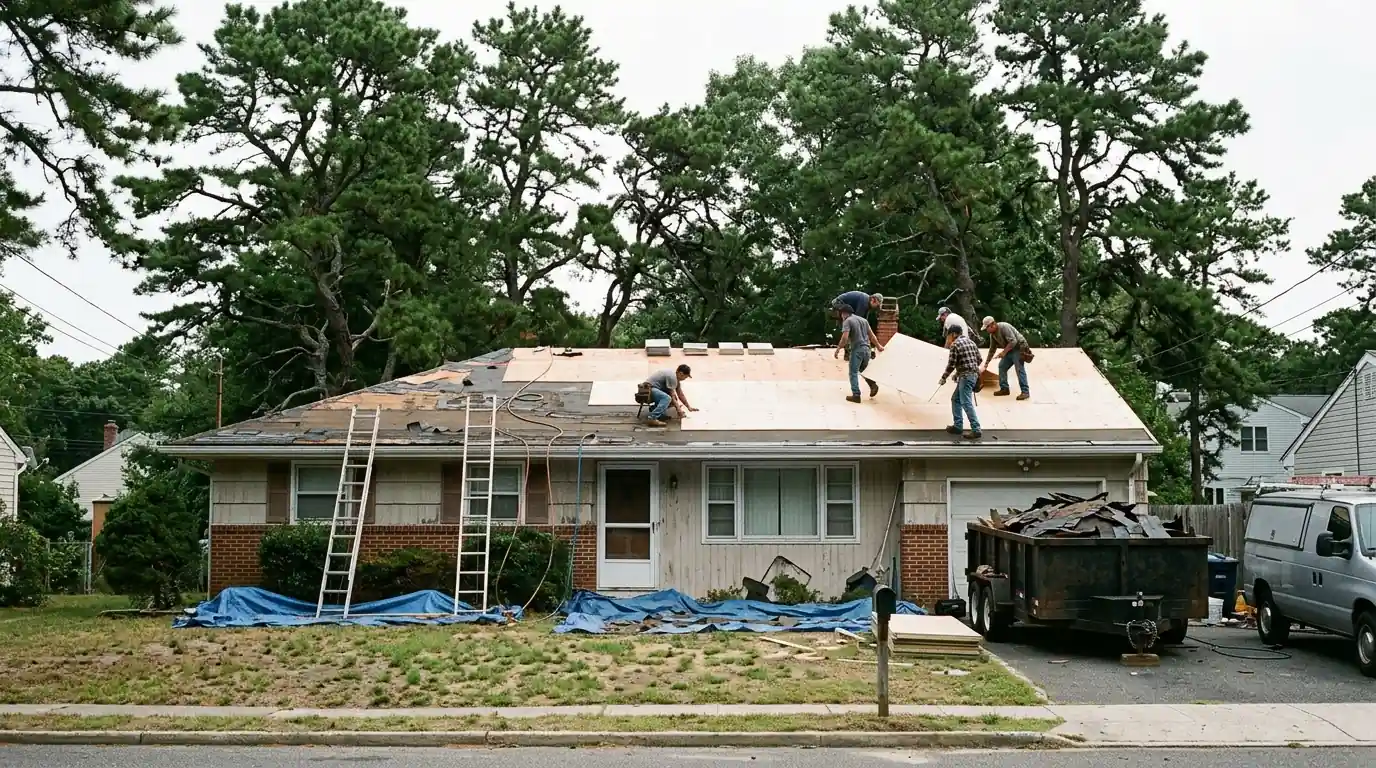
Roof deck repair means cutting out rotted, soft or delaminated sheathing and replacing it with new plywood or OSB, then re-nailing the remaining deck to current fastening patterns. In Toms River we do it most often during a reroof, priced per sheet, and also as a standalone repair under a leak. Call (732) 419-1462 to have your deck checked.
Plank, plywood or OSB: what's under your shingles
The deck material on your home depends largely on when it was built and how many times it has been reroofed. Each one fails in its own way.
| Deck type | Where we find it | How it usually fails |
|---|---|---|
| Solid plank boards (1x6 or 1x8) | Older cottages and some 1950s homes near the bay | Gaps open between boards, knots fall out, and ends split at the rafters |
| Spaced plank (skip sheathing) | Homes that once had wood shakes | Not solid enough for asphalt shingles until overlaid with new sheathing |
| Plywood sheathing | Most homes from the 1960s through the 1990s | Layers separate after repeated leaks, and edges soften at the eaves |
| OSB sheathing | Most homes and additions since the late 1990s | Swells at edges when wet, loses nail grip and stays soft once soaked |
| Fire-retardant treated plywood | Some townhomes and attached units | Can darken and weaken with heat in hot attics, so we check it carefully |
Clues that the deck needs work, not just the shingles
Some of these are visible from the yard, others only in the attic. Any one of them is worth a closer look before your next roof goes on.
A wavy or sagging roof line
Sighting along the roof from the street, you may see dips between the rafters. Sheathing that has softened or was too thin for the rafter spacing gives way slowly under shingle weight and snow.
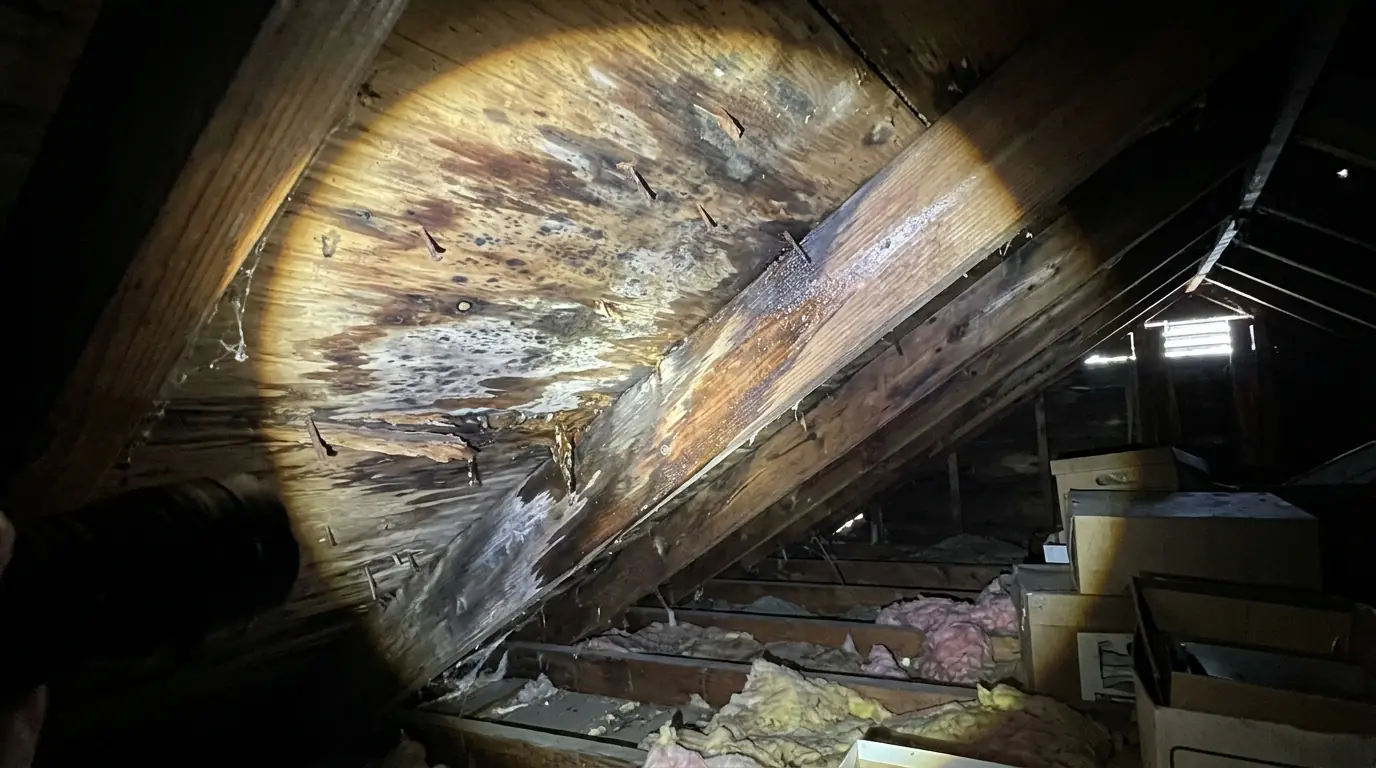
Dark stains on the attic side
Black or gray patches on the underside of the sheathing point to leaks or condensation. Wood that has been wet for years often turns soft even if the roof above looks normal.
Rusted nail tips poking through
Frost builds up on nail points in cold attics and drips on the wood around them. Rings of rot around many nail tips usually mean an attic moisture problem, not just a single leak.
Soft spots underfoot on the roof
A roof that gives when you step on it has a deck that's losing strength. Our roofers feel for this on every slope during an inspection or tear-off.
Popped nails across the field
When nails keep backing out all over the roof, the sheathing has often lost its grip. New shingles nailed into the same tired wood will do the same thing.
How deck repair fits into a tear-off
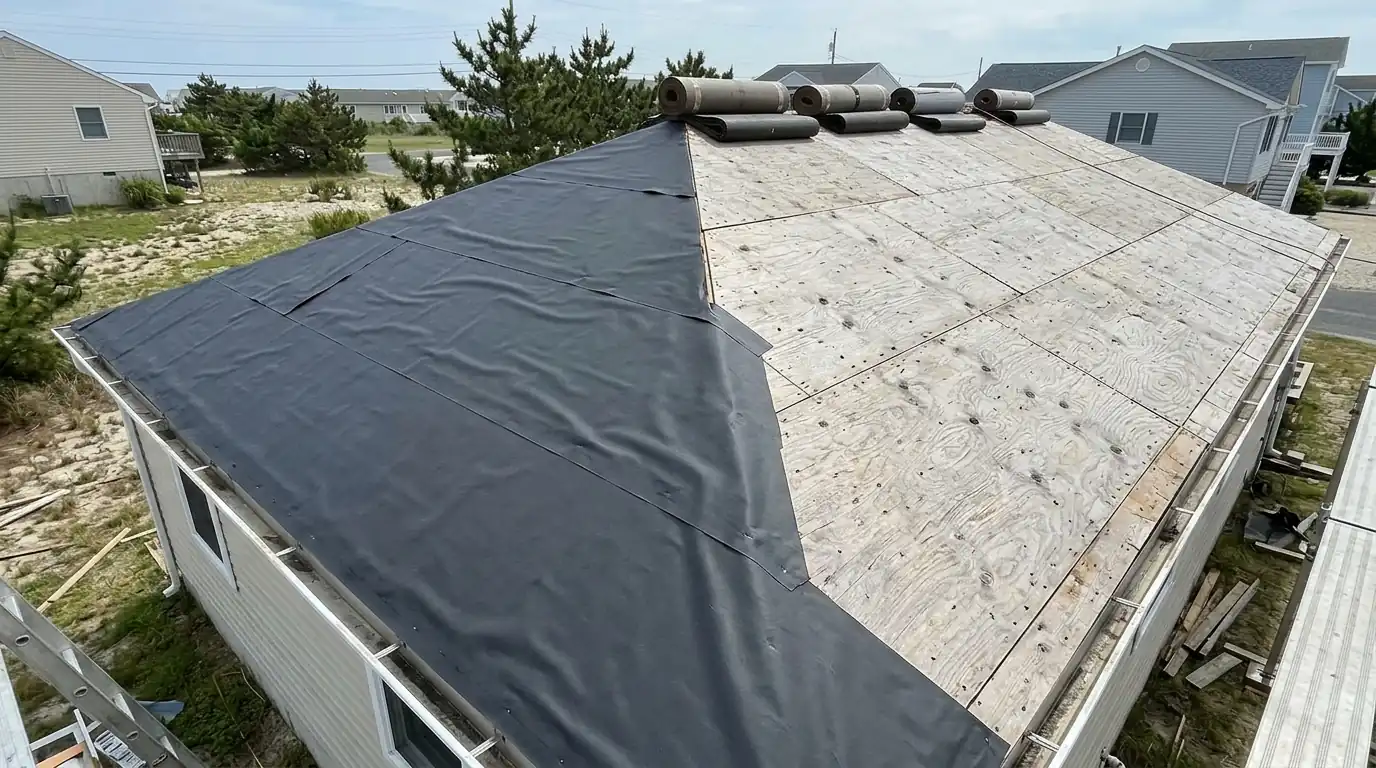
Most deck work happens on reroof day, after the old shingles come off and before anything new goes down. Here's how that window is used.
Tear off to bare wood
Old shingles and underlayment come off one section at a time, so no more of the house is open than we can cover the same day if the weather turns.
Day 1, morningWalk and sound the whole deck
Our roofers walk every sheet, probing soft areas and checking edges at the eaves, valleys and around chimneys. Bad sheets are marked and photographed so you see exactly what's being replaced.
Day 1, middayCut out and replace bad sheathing
Damaged sections are cut back to the nearest rafters and replaced with new plywood or OSB of the same thickness, with H-clips between rafters where spans call for them.
Day 1, afternoonRe-nail the remaining deck
Sheets that stay get added fasteners along the rafters to meet the current spacing pattern. On high-wind exposures near the water, ring-shank nails give the deck much better grip.
Day 1, afternoonDry in before day's end
The repaired deck gets ice and water barrier at the eaves and valleys and synthetic underlayment across the field, so the house is sealed before the crew leaves.
Day 1, late afternoon
What deck and sheathing repair usually costs
Deck repair is priced per sheet or per section in 2026, and it's often listed as a line item in a reroof proposal so there are no surprises.
| Work | Typical range | What moves the number |
|---|---|---|
| Replace one 4x8 sheet during a reroof | $115 to $185 | Sheet thickness, plywood versus OSB and whether H-clips are added |
| Re-nail the full deck during a reroof | $385 to $1,240 | Roof size and the fastener type, with ring-shank costing more |
| Overlay a plank deck with new sheathing | $4,180 to $9,650 | Roof area and whether the planks need repair first |
| Standalone deck repair under a leak | $865 to $2,740 | Number of sheets, shingle removal and reinstall, and roof height |
Your cost depends on how much sheathing is actually damaged, which is only certain once the old roofing is off; we photograph and count each sheet so the final number is clear.
Fixing the cause so the new deck stays dry
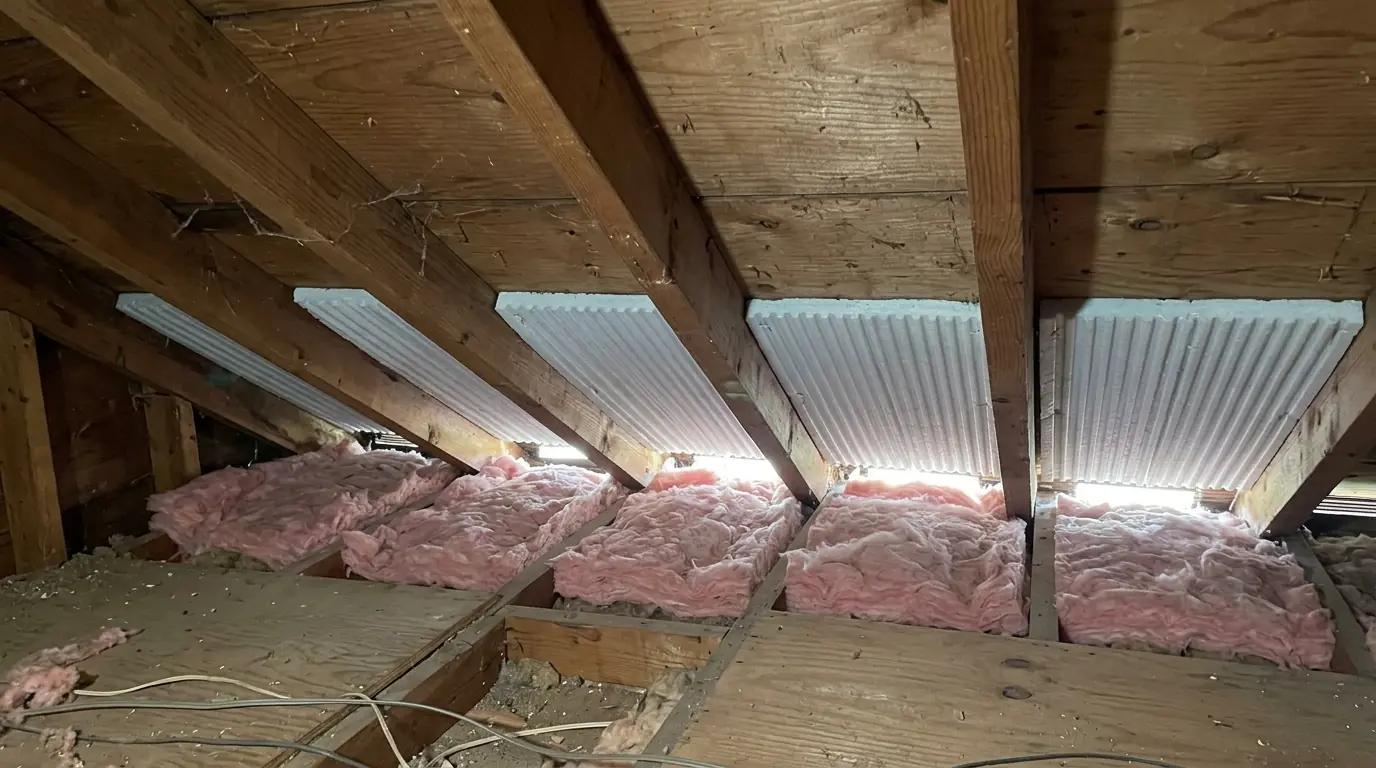
Replacing soft sheathing without asking why it went soft is half a job. A single dark patch under a chimney points to flashing. Rot along the eaves often comes from ice dams or gutters overflowing behind the fascia. Widespread staining and frosted nail tips nearly always trace back to weak attic airflow, and that's something ventilation work can correct while the roof is open.
Once the deck is sound, new shingles lie flat and hold their fasteners the way the maker intends. Most manufacturers, including GAF, IKO and Atlas, call for a solid, dry deck of a minimum thickness as part of their installation instructions. The full process is described on our roof replacement page, and our cost guide shows how deck repair fits into the total.
Questions to settle before your reroof starts
Talking these through before tear-off day keeps the deck part of the job clear and predictable.
- How is deck replacement priced in the proposal, per sheet or per section?
- Will I see photos of each damaged sheet before it's covered?
- Is the new sheathing plywood or OSB, and what thickness?
- Will the remaining deck be re-nailed, and with what type of nail?
- Do my rafter spacings call for H-clips or thicker sheathing?
- Is my older plank deck getting an overlay, and how does that affect the roof edge?
- What caused the rot, and what's being done about it?
Roof decks under Toms River's humid summers and coastal winters
Ocean County attics work hard. Humid summers off Barnegat Bay load the air with moisture, and cold, damp winters condense that moisture on the underside of the sheathing. Homes with weak soffit intake, bath fans venting into the attic or insulation packed against the eaves show it first, with dark sheathing and rusty nail tips. Pine needles in valleys and gutters hold water against the roof edge and soften the sheathing behind the drip edge.
The age of the house shapes what we find. Many 1950s and 1960s capes and ranches near the bay still have plank decks under several generations of shingles. Bi-levels and split-levels from the 1970s usually have plywood, sometimes with layers separating along the eaves. Newer colonials and many homes raised after Sandy use OSB, which is sound when dry but quick to swell where a leak has been left alone.
Where we do this work most
We work across all of Toms River (08753, 08755 and 08757) and these neighboring towns every week, along with the rest of Ocean County and southern Monmouth County.
- Silverton, Toms River08753
- Pleasant Plains, Toms River08755
- West Dover, Toms River08755
- Ortley Beach, Toms River08751
- Lakewood08701
- Brick08723
- Jackson08527
- Howell07731
- Manchester08759
- Berkeley Township08721
- Lacey Township08731
- Stafford Township08050
- Barnegat08005
- Wall Township07719
- Freehold07728
- Point Pleasant08742